
Vision isn’t just a sense—it’s how you experience life in its full color and clarity. But for millions, blurry sight can turn even the simplest moments into a struggle, holding back confidence and everyday ease. Glasses and contact lenses help, but what if you could go beyond temporary fixes?
Enter LASIK—a game-changing breakthrough in vision correction. Quick, precise, and transformative, LASIK offers more than just clear sight; it offers freedom. Freedom to wake up and see clearly, to live spontaneously, and to experience the world without limits. Because when your vision is clear, so is everything else.
LASIK (Laser-assisted in situ keratomileusis)
LASIK eye surgery is the best known and most commonly performed laser refractive surgery to correct vision problems. LASIK can be an alternative to glasses or contact lenses
During LASIK surgery, a special type of cutting laser is used to change the shape of the cornea. The cornea is the dome-shaped clear tissue at the front of the eye.
In eyes with typical vision, the cornea bends — or refracts — light precisely onto the retina at the back of the eye. But with nearsightedness, farsightedness or astigmatism, the light is bent incorrectly. This incorrect refraction causes blurred vision.
Glasses or contact lenses can correct vision, but reshaping the cornea also provides the refraction needed to correct vision.
Why LASIK?
This enhances your sight and corrects common problems like
- Myopia (nearsightedness) – Close objects can be seen, but distant ones are difficult to discern.
- Hyperopia (farsightedness) – When near objects are more blurry than far ones.
- Astigmatism – Blurred or distorted vision caused by a non-uniform curvature of the cornea.
The convenience of LASIK is that it can treat all these issues in just minutes per eye, with minimal pain and rapid recovery.
How LASIK Works
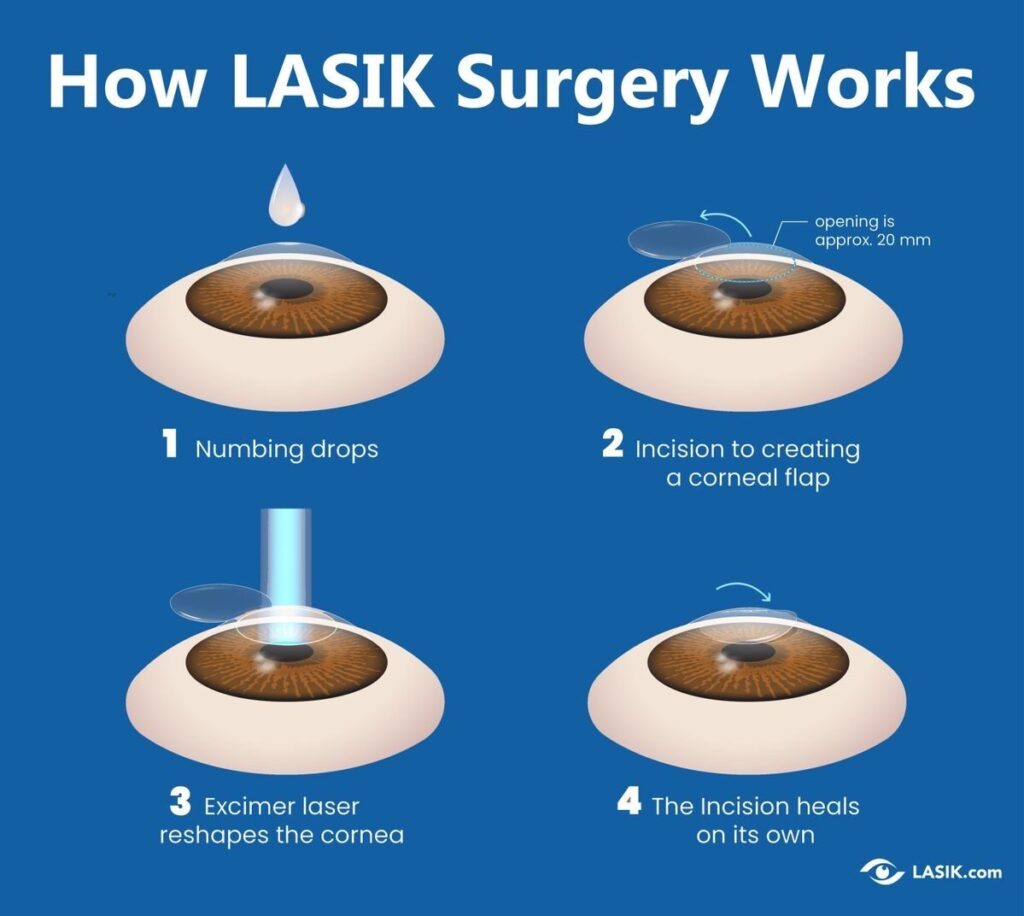
LASIK eye surgery is a quick and precise vision correction procedure, which is usually completed within 30 minutes. It involves creating a thin corneal flap, reshaping the cornea with a laser to correct refractive errors, and then repositioning the flap to heal naturally. The process is virtually painless and offers faster recovery.
Before Surgery-
The procedure is quick, usually done within 30 minutes. It begins with numbing drops placed in the eyes to prevent discomfort. The surgeon uses an instrument to hold the eyelids open, and a suction ring is applied before creating the corneal flap. This may cause slight pressure or temporary blurred vision.
During Surgery-
A femtosecond laser or microkeratome blade is used to create a thin flap in the cornea. The flap is lifted, and the cornea is reshaped with a programmed laser to correct refractive errors such as myopia, hyperopia, or astigmatism.
After Surgery-
Once the reshaping is complete, the flap is gently laid back into place and allowed to heal naturally. Stitches are not required, and most patients recover quickly, experiencing only mild, temporary side effects, such as dryness or slight blurring.
Are you eligible for LASIK?
- You have stable vision for 1 year
- You are older than 18 years of age
- Your eye power is within the safe limits for correction
- LASIK can be performed if your eye power is within certain ranges –
Myopia: -0.50 to -10.00
Hyperopia: +0.50 to +4.00
Astigmatism: +/- 0.50 to +/- 4.00 - Your corneal thickness is adequate
- When you come for a pre- LASIK check up, we measure your corneal thickness. If the corneal thickness is adequate (>500 microns), and you meet other criteria for LASIK- vision correction surgery can be done safely for you. If your corneal thickness is not adequate- LASIK is NOT safe for your eyes as it can lead to complications in the future. Your surgeon may suggest PRK (EpiLASIK) or ICL if your corneal thickness is less.
- You do not suffer from Systemic illness and illnesses affecting your immunity, impairing your ability to heal such as –
Diabetes
Rheumatoid Arthritis
Lupus
HIV
Other autoimmune diseases
Or Severe heart disease
Eye conditions such as–
Glaucoma
Cataracts
Corneal diseases
Severe Dry Eye
Large Pupils
Inflammation (such as keratitis or uveitis)
Infections (such as herpes simplex)
Eye injuries or disorders
- Other factors to consider-
- If you’re Pregnant or Lactating, please wait. Temporary fluctuations in eyesight can occur during this time.
- If you’re on medication like Isotretinoin, LASIK may have to be deferred for a bit.
- Pupil diameter
Pupil diameter is an important factor in LASIK surgery. If you have large pupils, you may not be able - Schirmers Test: Schirmers value of < 10 mm in 5 minutes indicates Dry Eye. LASIK can be done after treatment Dry Eye.
- To be remembered that LASIK correction surgery improves vision and a few people may still require glasses after this or as they age and presbyopia sets in.
Talking Risks
LASIK is safe, as is any surgery, but it carries potential risks:
- Dry eyes (temporary in most situations)
- Glare, halos, or nighttime vision
- Undercorrection or overcorrection (might need correction)
- Flap complications (rare)
Select a qualified LASIK surgeon and center to reduce these risks.
Success Rates
LASIK has a highly high success rate:
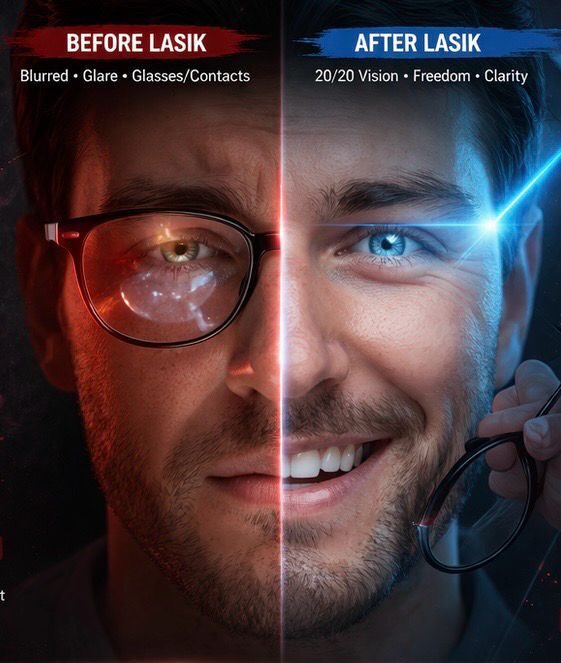
- More than 96% of patients enjoy 20/20 vision or better
- More than 90% satisfaction rate consistently
- Retreatments or touch-ups are performed in a very small percent
It is helpful to know that although LASIK can really enhance your vision, there will be varying results to a certain degree depending on how severe your prescription was and the condition of your cornea.
Glasses, Contacts, or LASIK — Which Is Right for You?
| Glasses | Contacts | LASIK | |
| Cost | Low | Medium | High |
| Convenience | High | Medium | Very high |
| Risk | Minimal | Low | Low |
| Permanence | No | No | Yes |
The best choice really depends on your lifestyle, budget, and comfort with risk. A consultation with an eye doctor is the best way to find out which option suits you.
Advantages of LASIK
- More convenience
- Nearly immediate vision improvement
- Long-term cost savings
- Permanent correction of shortsightedness and longsightedness and astigmatism
- Boosted self-confidence
- Lower risk compared with contact lenses or lens-based surgery
- Positive impact on eye allergies
- High patient satisfaction
- Virtually painless procedure
- The quick and easy recovery process
LASIK has transformed the way vision problems are treated, offering millions of people a safe and effective alternative to glasses and contact lenses. With its quick procedure, minimal discomfort, and rapid recovery time, it has become one of the most popular vision-correction surgeries in the world. While it may not be suitable for everyone, proper consultation with an eye specialist can help determine if LASIK is the right choice. For many, it opens the door to clearer vision and a life with greater convenience and confidence.