


The problem:
How many times has it occured to you that you sit down to work or study,thinking you’ll atleast sit for an hour and suddenly your phone rings up,you get a notification and you reach out for your phone and behold an hour passes by while you were struck in the constant loop of “one last reel/text”!…..
In today’s world of constant distractions,the ability to sustain attention has almost become impossible particularly for students and professionals. By examining current neuroscientific evidence, this article provides a clearer understanding of how deep focus is achieved at the brain level and discusses its relevance in medical education and cognitive performance.
Understanding the flow state:
So, first of all what even is the flow state !?
What if i tell you all of us have experienced flow state in our life,
You know that feeling when you are playing your favourite sport or are playing a game and suddenly you forget about everything else ,even the time feels like it just flew by ….YES that’s exactly when you are said to be in a flow state !
So, basically flow state is a mental state of complete absorption and focus in an activity, characterized by intense concentration, loss of self-consciousness, and altered time perception (time flies or slows down).
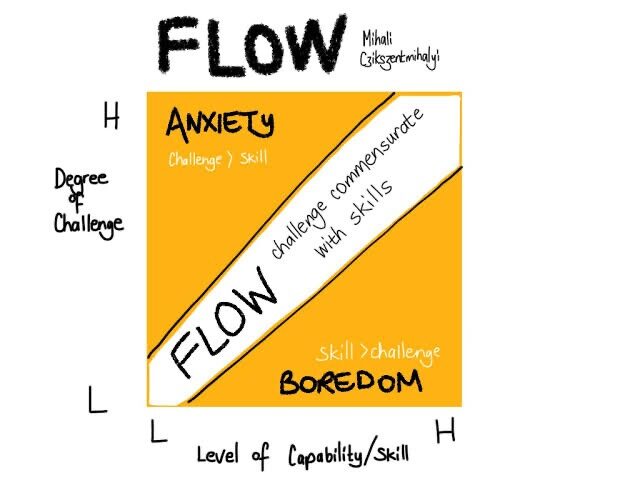
A defining feature of flow is the balance between task challenge and individual skill level.
> Tasks that are overly simple fail to sufficiently engage attentional systems, leading to boredom.
> while excessively difficult tasks provoke anxiety and cognitive overload.
Flow emerges when task demands slightly exceed existing skill levels, encouraging focused effort without overwhelming cognitive capacity.
What Happens in the Brain During Flow:
When the brain enters a flow state, changes occur in neurochemical signaling. Two neurotransmitters play a central role:
>Dopamine
>Norepinephrine
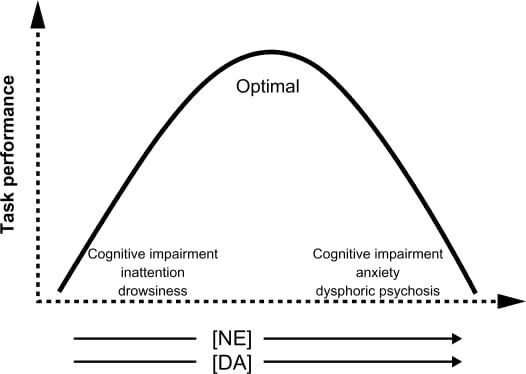
(NE – NOREPINEPHRINE; DA – DOPAMINE)
> Dopamine is involved in motivation, reward, anticipation, and sustained engagement. During flow, dopamine release reinforces task-related behaviors, making the activity feel intrinsically rewarding rather than effort full .This explains why individuals in flow often continue working without conscious effort or external incentives, because they totally are not taking that task as a burden when they are in flow!
> Norepinephrine regulates alertness and attentional precision. Moderate levels of norepinephrine allow the brain to prioritize task-relevant information while suppressing distractions. Excessive levels, however are associated with stress and anxiety, which disrupt focus.
What the Brain Needs to Enter Flow (and How You Can Create It):
So, now that you know what the flow state actually is and the neurochemicals involved in it , here comes the important question :
How do I enter into the flow state !?
Flow does occur randomly. It emerges when specific brain-friendly conditions are met. Understanding these conditions allows individuals to deliberately increase the likelihood of entering deep focus.
1. Optimal arousal levels
The brain functions best at moderate levels of arousal.
> Excessive stress elevates cortisol (A hormone that increases during stress) , impairing working memory and attention.
> while low arousal leads to boredom and disengagement.
Solution :
Choose demanding tasks during periods of mental alertness.
Identify when in the entire day ,are your energy levels high ,and preferably do your most difficult task at that time of the day.Even brief physical activity can help raise arousal when energy is low.
2. Challenge–Skill Balance
Flow is most likely when task difficulty slightly exceeds current ability.
This engages attentional and reward systems without overwhelming cognitive control.
Solution:
Break large goals into smaller tasks with gradually increasing difficulty rather than attempting complex tasks all at once.
If the task was too easy you would easily lose interest , if it was too difficult you would easily give up!
3. Reduction of Cognitive Noise
Distractions force the brain to repeatedly shift attention, preventing stabilization of the neural state required for flow.All those notifications that you get ,those reels that you endlessly doomscroll ,they will never let you enter into a flow state.
Solution:
>Single-tasking-Do one thing at a time ,while studying,while playing play !
>Silencing notifications, and defining a clear task goal before starting significantly improves the brain’s ability to remain focused.
4.Time-Bound Focus Cycles
Sustained attention follows biological rhythms, with peak focus lasting approximately 60–90 minutes.
Solution:
Work in fixed-duration focus blocks followed by short breaks to allow neural recovery and prevent cognitive fatigue.
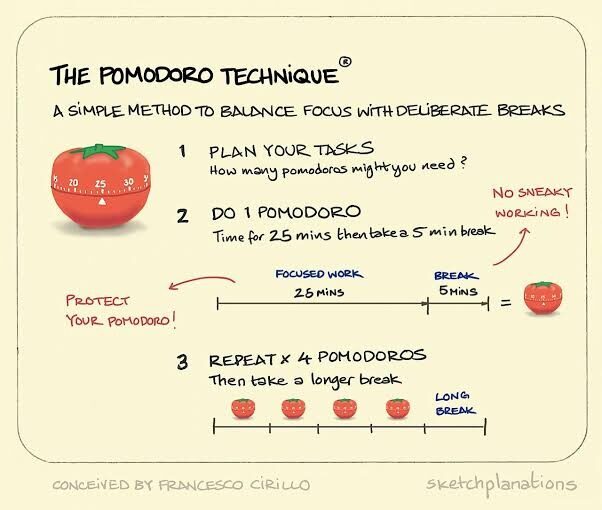
This is exactly how the POMODORO TECHNIQUE works !
You do your works in chunks of 25 minutes and then take a 5 break,
After you have successfully completed 4 cycles of pomodoro you take one long 15 minute break!
If this time interval feels too short for you,you can also work in intervals of 50 minutes followed by a 10 minute break!
Applying Flow in Learning and Skill Development:
- Flow state has particular relevance in learning environments that demand prolonged concentration, such as medical education.
- Students who structure their study sessions to align with flow principles—clear goals, minimal distractions, appropriate challenge, and time-bound focus—often report improved retention and reduced mental exhaustion,hence leading to better performance in exams and vivas !
- Importantly, flow shifts the emphasis from discipline-driven study to designing “conditions that support the brain’s natural attentional mechanisms”
Beyond academics, flow principles are equally applicable to creative work, problem-solving, and skill-based training, reinforcing its value across professional and personal domains.
Conclusion: Designing Focus, Not Forcing It!
Deep focus is not a matter of willpower alone !
Flow state represents a distinct neurocognitive condition shaped by attention networks, neurotransmitter balance, and environmental factors.
By understanding what the brain requires to enter this state, individuals can move away from forceful concentration and toward intentional design of their work and learning environments.
In a world increasingly hostile to sustained attention,
With all the big companies fighting for our most important assets, our focus and our time , cultivating flow may be less about resisting distraction and more about creating the conditions in which the brain can do what it does best.
References:
‘DEEP WORK’ by Cal Newport.
‘The pomodoro technique’ by Francesco Cirillo.