

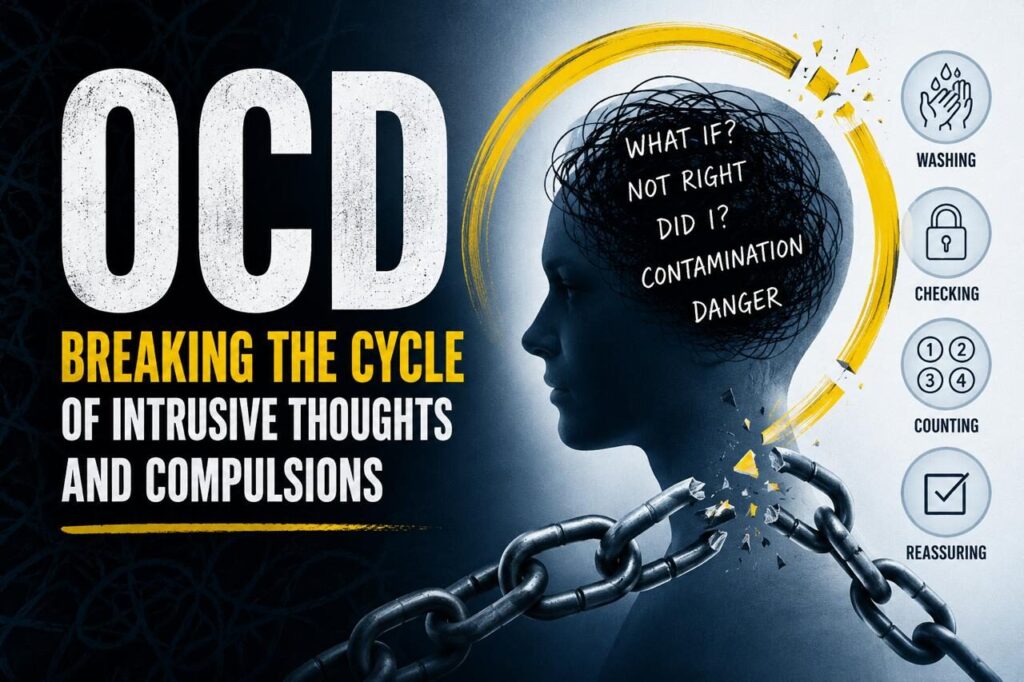
Have you ever had a thought that frightened you so much that you wished it would just disappear? Or felt temporary relief after performing a certain action to silence that thought?
For some people, these thoughts are not occasional. They are repetitive, unwanted, and extremely distressing. To escape the anxiety, individuals may feel forced to perform certain actions again and again. This cycle of intrusive thoughts and repetitive behaviors is called Obsessive-Compulsive Disorder (OCD).
OCD is a term that people generally use when they see a person obsessed with cleanliness or someone who wants everything organized. However, OCD is not limited to cleanliness; it is a complex mental health condition.
What is Obsessive-Compulsive Disorder (OCD)?
OCD is one of the most common mental health conditions, wherein a pattern of unwanted thoughts and fears (obsessions) leads to repetitive behaviors (compulsions) that interfere with daily life and responsibilities.
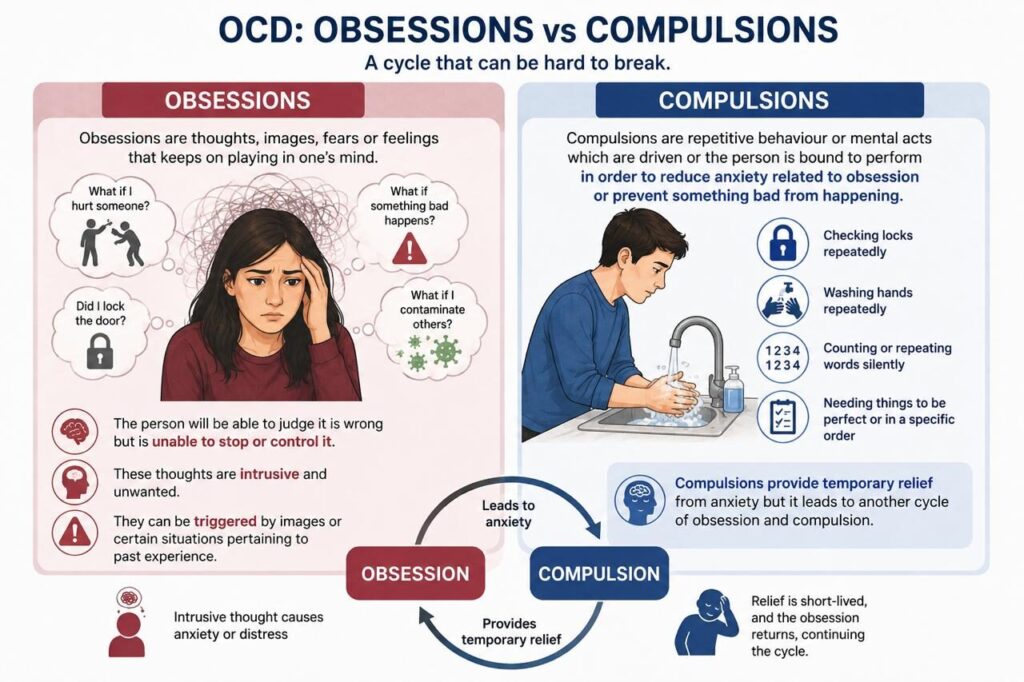
Obsessions are thoughts, images, fears, or feelings that keep playing repeatedly in one’s mind. The person is able to recognize that these thoughts are irrational but is unable to stop or control them.
These thoughts are intrusive and can be triggered by images or certain situations pertaining to past experiences.
Compulsions are repetitive behaviors or mental acts that a person feels driven or compelled to perform in order to reduce anxiety related to an obsession or to prevent something bad from happening.
Compulsions provide temporary relief from anxiety, but they eventually lead to another cycle of obsessions and compulsions.
| OBSESSION | COMPULSION |
| Repetitive and uncontrollable thoughts, images, fears or feeling | Repetitive and uncontrollable behaviour or mental acts to reduce anxiety |
| Causes significant distress | Provide temporary relief but leads to another cycle of obsession and compulsion |
| Example: Thoughts of something bad happening when things are not arranged in a particular order. | Example: over arranging things in a particular order. |
Epidemiology
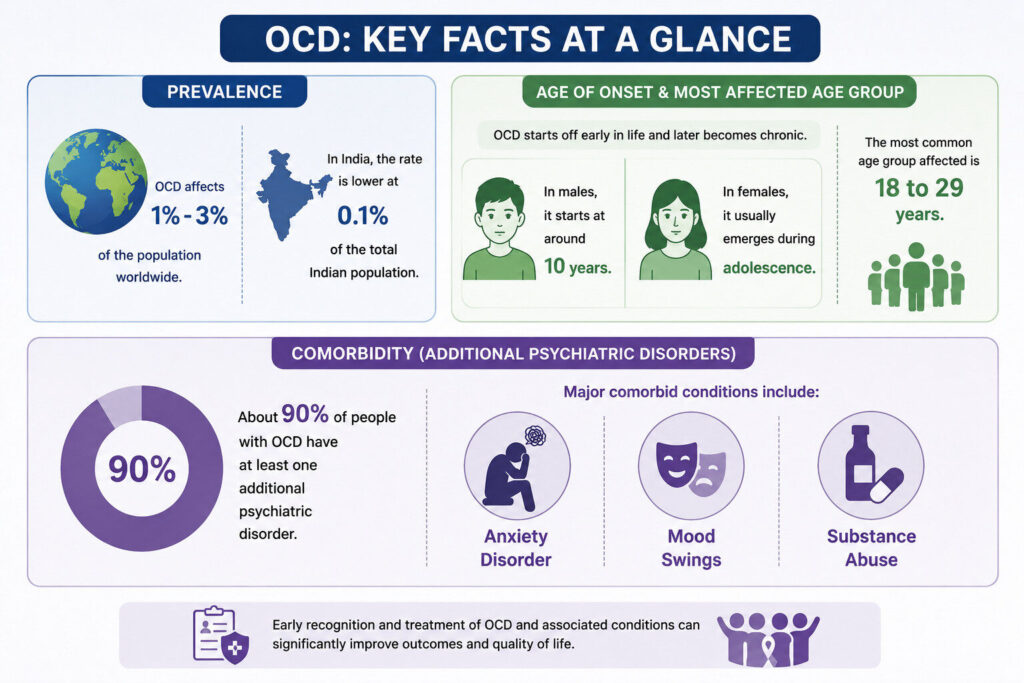
According to the NIH, OCD affects 1%–3% of the population worldwide. However, the reported prevalence is lower in India, accounting for 0.1% of the total Indian population.
OCD starts early in life and later becomes chronic. The most commonly affected age group is 18 to 29 years. In males, it often starts at around 10 years of age, whereas in females, it usually emerges during adolescence.
About 90% of people with OCD have at least one additional psychiatric disorder, with anxiety disorders, mood disorders, and substance abuse being the major comorbid conditions.\
Risk Factors
Family history: If any family member has a history of OCD, the individual is more likely to develop the disorder. However, the exact pathogenesis behind this familial transmission is not yet known.
Stressors: If an individual experiences a traumatic or stressful event, they are more likely to develop distressing thoughts. These thoughts may then lead to certain actions performed to relieve anxiety.
Personality traits: People with perfectionistic tendencies, a high sense of responsibility or guilt, and a strong ego are at a higher risk of developing OCD.
Environmental factors: Parental abuse, overprotective parenting, or a highly critical family environment can lead to depression and anxiety, thereby increasing the risk of OCD.
Other mental health disorders: As mentioned earlier, other mental disorders such as depression, anxiety, tic disorders, and substance abuse also contribute to OCD.
Causes
The exact cause of OCD is unknown, but there is cumulative evidence suggesting several contributing factors.
Genetic causes
A family history of OCD is one of the major contributing factors, wherein first-degree relatives (mother, father, sister, brother, son, or daughter) have a higher chance of developing OCD. However, the specific gene responsible has not yet been identified.
Learning
A person may develop certain behaviors by observing elders or people they admire. A classic example is a child growing up watching parents constantly checking locks, cleaning excessively, or being overly concerned with order and symmetry.
Brain abnormalities
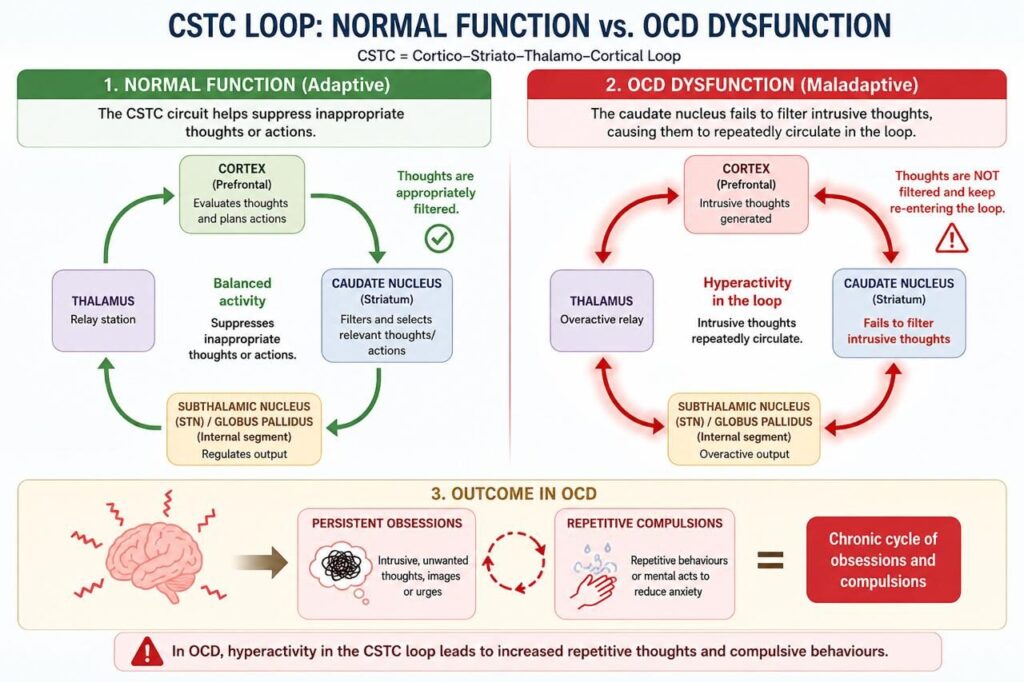
Cortico-Striato-Thalamo-Cortical (CSTC) circuit dysfunction: The caudate nucleus fails to filter intrusive thoughts, causing them to repeatedly circulate within the loop.
Neurotransmitter abnormalities: Dysfunction in serotonin, dopamine, and glutamate signaling may also contribute to OCD.
Infection-related immune mechanism (in children): In some children, OCD symptoms can appear after a streptococcal infection. This condition is known as PANDAS (Pediatric Autoimmune Neuropsychiatric Disorders Associated with Streptococcal Infections), in which antibodies affect the basal ganglia.
Symptoms of OCD
Obsession symptoms
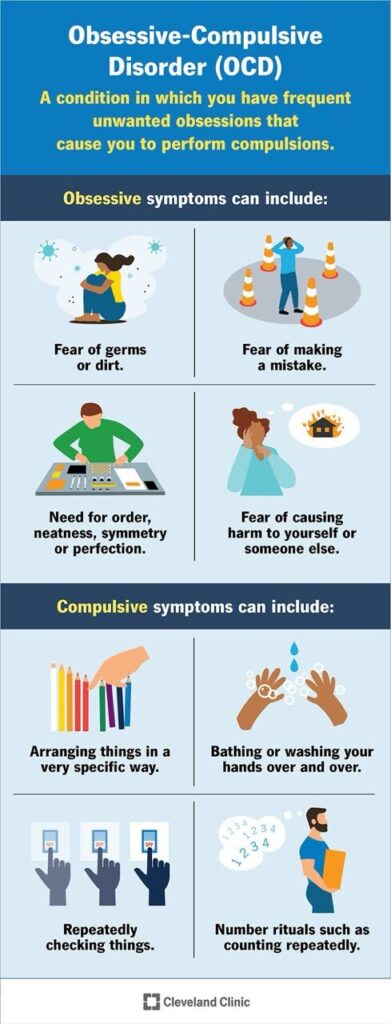
- Checking door locks multiple times or driving back to the same place to check whether something has been lost.
- Religious obsessions:
- Believing certain religious myths or rituals, or having intrusive thoughts about spirituality that disturb one’s peace of mind.
- Dirt contamination:
- One of the most common symptoms for which people often mistakenly diagnose themselves with OCD.
- Fear of germs or dirt contamination.
- Avoiding touching people or being touched by others.
- Sexual obsessions:
- Intrusive sexual thoughts about family members (incest).
- Thoughts involving children (fear of becoming a pedophile).
- Sexual thoughts about religious figures or sacred objects.
- Doubts about one’s sexual orientation.
- Fear of losing control and touching someone or saying something sexually inappropriate.
- Sudden graphic sexual images entering the mind unintentionally during normal activities such as talking, studying, or praying.
- Excessive guilt about normal sexual thoughts.
- Responsibility obsessions:
- Fear of being responsible for something terrible happening.
- Fear of harming others due to not being careful enough.
Compulsion symptoms
Obsessions are usually followed by compulsions.
Cleaning
- Excessive handwashing that may lead to skin abrasions.
Checking
- Checking doors repeatedly to make sure they are locked.
- Checking the stove repeatedly to make sure it is turned off.
Counting
- Counting in certain patterns.
- Silently repeating a prayer, word, or phrase.
- Trying to replace a bad thought with a good thought.
Ordering
- Arranging canned goods so that they all face the same way.
Reassurance seeking
- Repeatedly demanding reassurance.
Normal habits and OCD behaviour
| Categories | Normal habits | OCD behaviour |
| Cleaning and washing | Washing hands before eating, after using restroom, keeping the house clean | Excessive cleaning and handwashing to overcome fear of contamination Washing hands till the skin barrier is damaged and they start bleeding Excessive sanitation of home for hours despite knowing it’s irrational |
| Checking | Checking once or twice if the stove is turned off or doors are locked | Mandatory urge to repeatedly checkReturn back to check if the door is locked for about 20 times |
| Order and symmetry | Wanting a desk organised but being able to leave it messy without feeling extreme anxiety | Needs things to be arranged highly precise and exact wayIf things are not perfectly symmetrical or aligned , they feel compelled to repeat the arrangement again till it feels right. |
| Reassurance | A compliment makes them happy | Need constant reassurance and compliment to make them feel confident , comfortable and safe |
A glimpse into the mind of a person with OCD
Many individuals with OCD silently struggle with thoughts such as :
- “What if something terrible happens because I didn’t check properly?”
- “What if I am a bad person for having these thoughts?”
- “I know this doesn’t make sense but I can’t ignore the feeling”
- “If I don’t perform this act ,I won’t be able to stop worrying “
- “I will just finish this ritual, I gives me relief and reduces my stress and anxiety “
Red flag signs: Alarming signings that need immediate help
- Compulsive actions that hampers daily activity or which takes more than an hour
- Reoccurrence of intrusive thoughts
- Checking becomes hard to stop
- Cleaning feels excessive
- Certain rituals feels necessary before moving on
- Demanding constant reassurance to feel confident and safe
- Symptoms cause shame or feel hard to discuss
- Symptoms are getting worse
What’s happening in your brain?
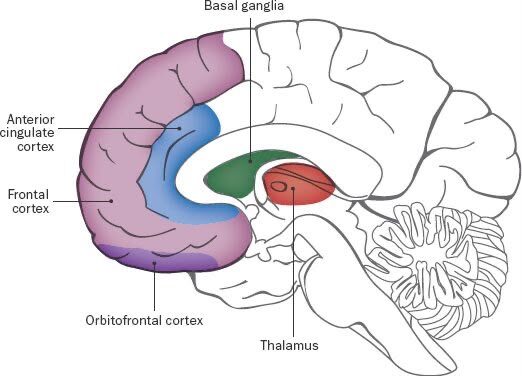
The exact pathogenesis is unknown, but Cortico-Striato-Thalamo-Cortical (CSTC) circuit dysfunction is considered one of the major pathophysiological mechanisms.
Certain areas of the brain whose abnormalities contribute to OCD include:
- Orbitofrontal cortex (OFC): Responsible for decision-making and evaluation of danger.
- Anterior cingulate cortex (ACC): Involved in error detection and emotional regulation.
- Basal ganglia (especially the caudate nucleus): Filters and regulates thoughts and actions.
- Thalamus: Relays signals back to the cortex.
Mechanism of the CSTC Loop
- Normally, this circuit helps suppress inappropriate thoughts or actions.
- In OCD, the caudate nucleus fails to filter intrusive thoughts, causing them to repeatedly circulate within the loop.
- This leads to persistent obsessions and repetitive compulsions.
- Hyperactivity in these brain regions further contributes to repetitive thoughts and compulsive behaviours.
Management and Treatment
Exposure and Response Prevention (ERP) therapy: A type of therapy in which a patient is exposed to their fears or other obsessions and is prevented from performing compulsive behaviour. Over time, the patient learns that the fear or anxiety naturally decreases without performing the compulsion.
Example: A person with a fear of contamination is encouraged to touch various objects without washing their hands.
Medications: Antidepressants help reduce obsessive thoughts.
Self help strategies
While professional medical help is the mainstay , self help strategies are the complementary therapy that help individuals to cope up with their symptoms.
1. Learn about OCD: Understanding that OCD is a mental health condition and not a character flaw empowers individuals to seek appropriate treatment.
2.Recognize Intrusive Thoughts for What They Are: Instead of treating intrusive thoughts as facts or warnings, acknowledge them as symptoms of OCD. Remind yourself that having a thought does not make it true or increase the likelihood of it happening.
3.Resist Compulsions Gradually:Although performing compulsions may provide temporary relief, it strengthens the OCD cycle in the long run. Gradually delaying or resisting compulsive behaviors, especially as part of Exposure and Response Prevention (ERP) therapy, can reduce their intensity over time.
4.Practice Mindfulness:Mindfulness techniques can help individuals observe intrusive thoughts without reacting to them. The goal is not to eliminate the thoughts but to let them pass without engaging in compulsions.
5.Manage Stress:Stress can worsen OCD symptoms. Regular exercise, adequate sleep, relaxation techniques, and engaging in enjoyable hobbies can help improve emotional well-being and reduce symptom intensity.
6. Avoid Constant Reassurance-Seeking :Repeatedly asking others for reassurance may temporarily reduce anxiety but often reinforces OCD. Learning to tolerate that is an important part of recovery.
7. Follow the Treatment Plan:If prescribed medication or attending therapy, continue the treatment as advised. Do not stop medications or discontinue therapy without consulting your healthcare provider.
How friends and family can help a person
When someone is navigating a health challenge, the support of family and friends isn’t just comforting—it is a crucial part of the recovery process. However, true loved ones often fail to help simply because they don’t know how to approach the situation without causing discomfort or overstepping boundaries.
- Initiate with Empathy, Not Judgment: Start the conversation in a private, low-stress environment. Instead of offering unsolicited medical advice or asking probing questions, focus on expression of care. Use “I” statements, such as, “I’ve noticed you’ve been feeling a bit under the weather lately, and I just want you to know I’m here for whatever you need.”
Listen Without Trying to “Fix” It: Instead of dismissing their fears with statements like “Just stop thinking about it” or “You’re overreacting,” listen to them without criticism and acknowledge that their distress feels very real to them. Its fine even if you are not able to empathise with them , listening to them venting out there issues for 5 minutes, makes them feel
- Normalize the Conversation: Remove the stigma or awkwardness by talking about health and recovery as a normal, manageable part of life. Acknowledging their discomfort without making them feel isolated makes it much easier for them to open up.
Practical Ways Friends and Family Can Help
- Lighten the Daily Load: When a person is unwell, everyday chores can feel monumental. Offer specific, tangible help rather than a vague “Let me know if you need anything.” Small actions—like taking care of a meal, running an errand, or helping keep their living space tidy—can relieve an immense amount of physical and mental stress.
- Support Medical Adherence: Without being overbearing, loved ones can help track medication schedules, ensure prescriptions are filled on time, or encourage proper hydration and rest.
- Accompany, Don’t Drive: Offer to walk with them to a clinic appointment or sit with them in the waiting room. Having a familiar face nearby provides a powerful psychological anchor and ensures they don’t feel like they are facing the healthcare system
Myths vs facts
Myth: OCD is just about being neat and organized.
Fact: OCD is much more than cleanliness. Many people with OCD struggle with intrusive thoughts related to harm, contamination, religion, relationships, or other themes, and may not have any concern with orderliness.
Myth: Everyone is “a little OCD.”
Fact: Being organized or liking things a certain way is not the same as OCD. OCD is a recognized mental health disorder that causes significant distress and interferes with daily life.
Myth: People with OCD can stop their compulsions if they really want to.
Fact: Compulsions are driven by overwhelming anxiety. Simply telling someone to “stop” is not helpful and often increases their distress.
Myth: Intrusive thoughts reflect a person’s true character or intentions.
Fact: Intrusive thoughts are unwanted, distressing, and inconsistent with the person’s values. Having these thoughts does not mean the person wants to act on them.
Myth: OCD is caused by weak willpower or poor parenting.
Fact: OCD is a complex condition influenced by genetic, biological, and environmental factors. It is not caused by laziness, weakness, or bad parenting.
Myth: OCD cannot be treated.
Fact: OCD is a treatable condition. Evidence-based treatments such as Cognitive Behavioural Therapy (CBT), particularly Exposure and Response Prevention (ERP), and medications can significantly reduce symptoms and improve quality of life.
Myth: Medication alone is the only treatment for OCD.
Fact: Treatment is individualized. Many people benefit from CBT with ERP, some require medication, and others benefit from a combination of both. Early intervention often leads to better outcomes.
OCD is a complex and long-lasting mental disorder. However, with proper medical care, along with understanding and support from peers, friends, and, most importantly, family members, individuals with OCD can better manage the fear, anxiety, and distress caused by the cycle of obsessions and compulsions.
References
- New oxford textbook of psychiatry – 3rd Edition
- Textbook of postgraduate psychiatry- 3rd Edition
- https://www.mayoclinic.org/diseases-conditions/obsessive-compulsive-disorder/symptoms-causes/syc-20354432
- https://en.wikipedia.org/wiki/Obsessive%E2%80%93compulsive_disorder
- https://www.nimh.nih.gov/health/publications/obsessive-compulsive-disorder-when-unwanted-thoughts-or-repetitive-behaviors-take-over
- https://my.clevelandclinic.org/health/diseases/9490-ocd-obsessive-compulsive-disorder