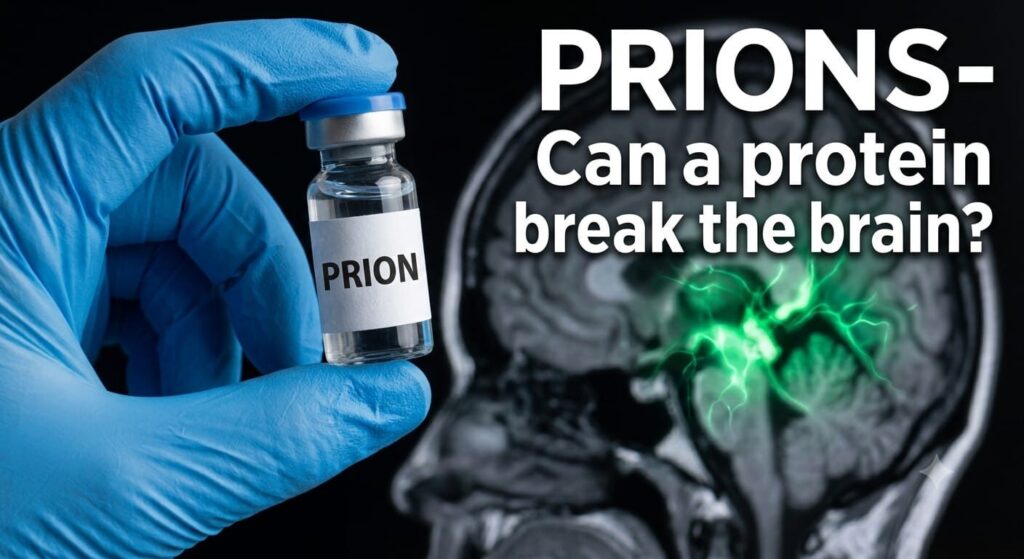
Prions-Can A Protein Break The Brain
Shilpa gazed affectionately at the picture and smiled to herself. It was a photograph of her wedding day and she was looking at her mother’s practically glowing face. Usually the bride’s mother would be in tears but her mom was overflowing with joy because she loved Shilpa’s to-be husband like a son already. Pradeep was intelligent, kind, well read, and most importantly-loved Shilpa to the moon and back, so it was no wonder that Shilpa’s mother was elated in that picture. But Shilpa’s smile slowly dipped into a thin line as she remembered how quickly it went downhill from there. In just 2 months her mother went from being the epitome of an independent elderly woman to slowly losing her memory and becoming unbalanced. By 4 months she was unrecognisable with severe amnesia, hallucinations and personality changes, and by 5 she was gone. Shilpa didn’t feel like she just lost her mother, she felt robbed of whatever last few months with her since she didn’t even seem like the same person anymore. Searching for answers she turned to her mother’s autopsy, the diagnosis was something she hadn’t ever heard of-CJD.
What exactly are prions?
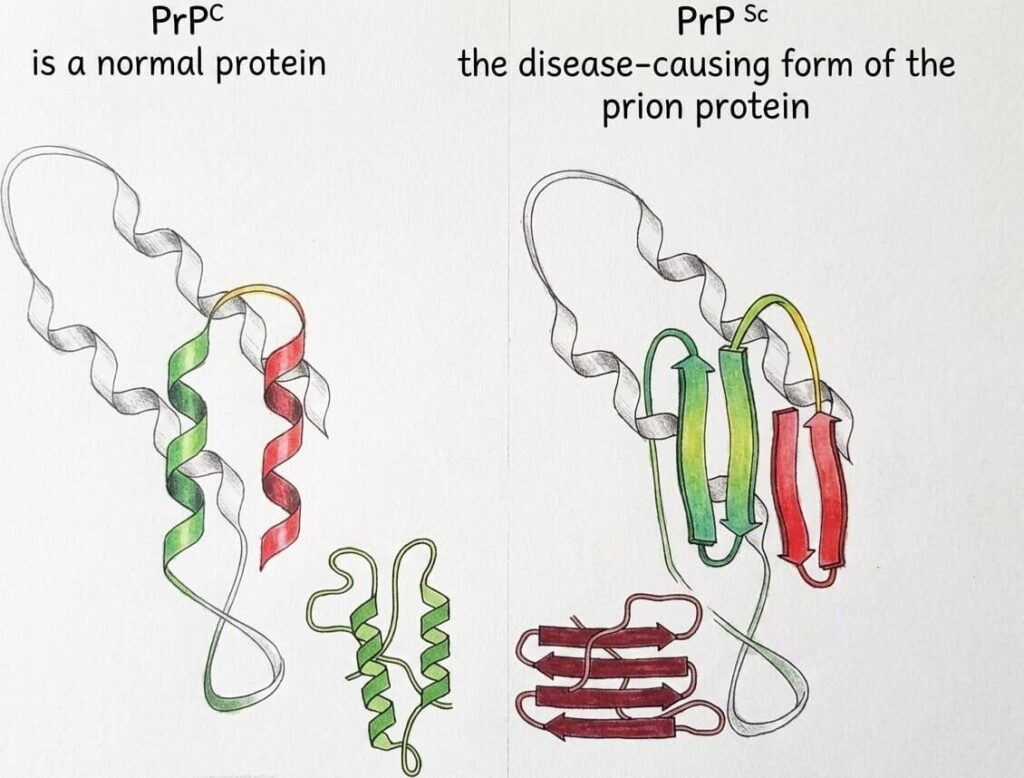
To answer that question we need to dive into a brain cell. Inside the brain cells there are ribosomes. These are the factories in the cell that synthesise proteins. For proteins to become fully functional they need to fold into some very specific shapes. Prions are a subgroup of cellular proteins. After folding they travel to the cell membrane to perform their duties. So, when properly folded they cause no harm. These are called PrPc which stands for normal prion protein.
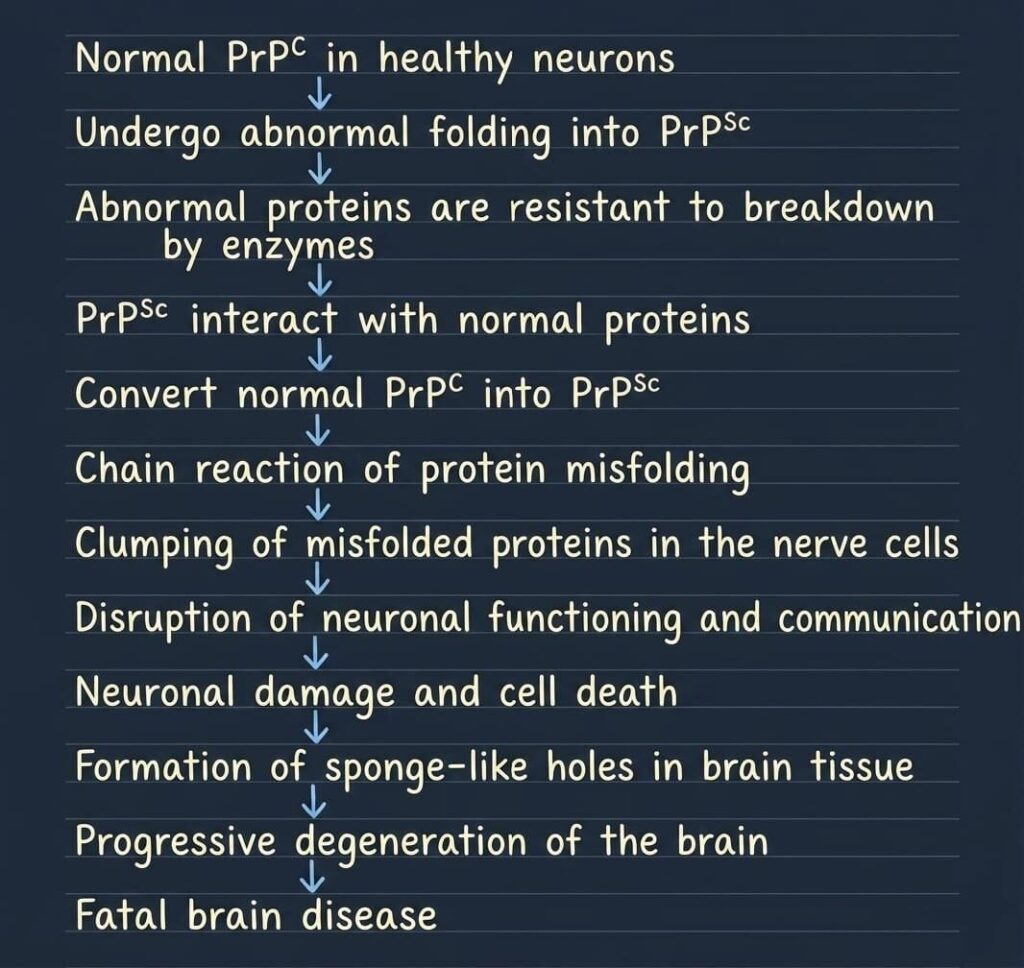
Very rarely these can be misfolded into an abnormal shape, these are called PrPSc or prion protein scrapie. These abnormal prion proteins not only self replicate but they also convert normal proteins into abnormal proteins in a chain reaction. These proteins eventually accumulate leading to cell death and spread to nearby cells to repeat the process yet again.
Hence, prion diseases-also called transmissible spongiform encephalopathies are a group of rare neurodegenerative disorders caused by the abnormal folding of proteins. There are quite a few kinds of prion diseases, such as Creutzfeldt-Jakob disease (CJD), Fatal familial insomnia, Kuru, and others. The animal prion diseases are Bovine Spongiform Encephalopathy (mad cow disease), Scrapie, and Chronic wasting disease. The most widespread of these diseases is CJD.
Understanding the cause
I’m sure after reading this the first thought would be how do we get prion diseases? Unfortunately unlike common diseases like malaria or influenza, prion diseases are mostly caused by reasons out of our control. As previously mentioned the root cause for prion diseases is the misfolding of proteins. For CJD specifically there are 4 known ways to contract it.
Modes of contraction
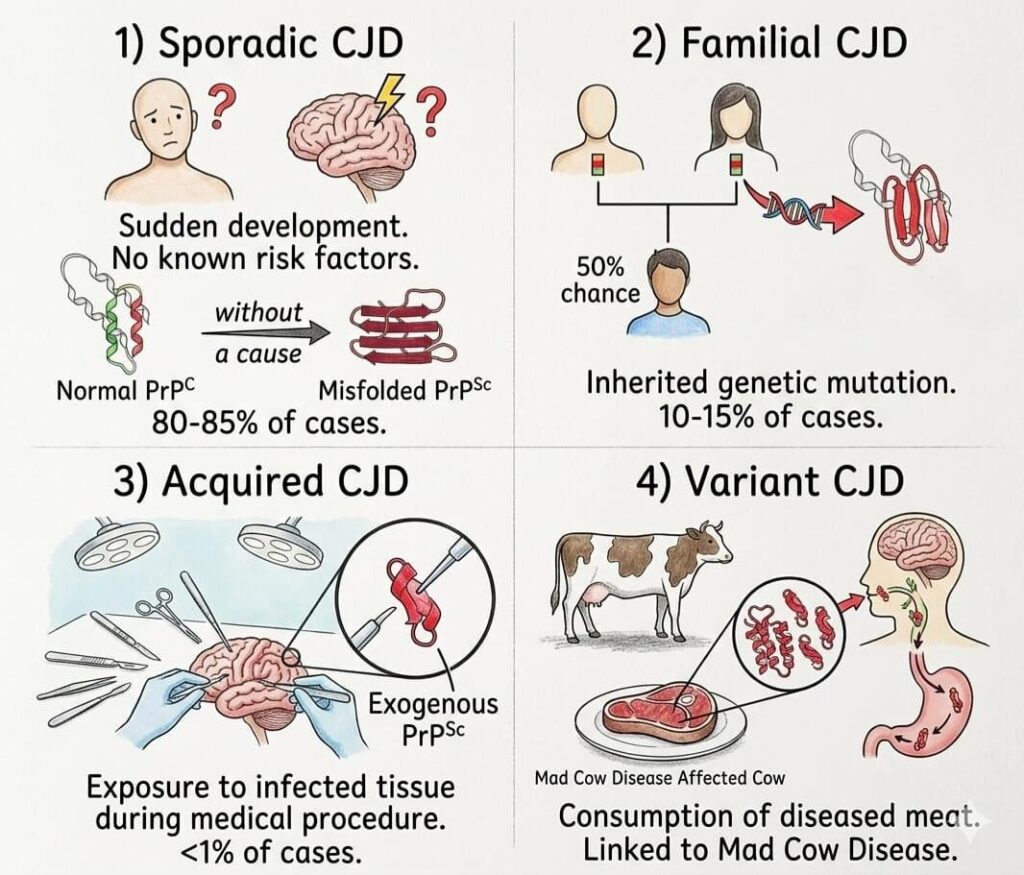
1)Sporadic CJD
This accounts for almost 80-85% of CJD cases in the world.Sporadic means that this form of CJD develops suddenly and without any known risk factors.
2)Familial CJD
This accounts for about 10-15% of CJD cases. This form of CJD occurs due to an inherited genetic mutation. If an individual has this mutation there is a 50% possibility of their child also having the mutation.
3)Acquired CJD
Less than 1% of reported CJD cases are due to this cause. Acquired CJD is caused by exposure to infected tissue during a medical procedure.
4)Variant CJD
This type of CJD is caused by the consumption of diseased meat such as meat from cows affected by mad cow disease.
The other prion diseases are also transmitted in similar ways.
Kuru is transmitted by the consumption of human brain tissue contaminated by infectious prions. Fatal insomnia can be hereditary or sporadic. Prion diseases in animals is usually caused by them consuming brain matter of the same species.
Should we be worried?
Although most of this sounds quite scary prion diseases are not very prevalent, with only 1 or 2 cases per million population. Prion diseases such as kuru and variant CJD have already been on the decline due to awareness around its cause.There is also actively a lot of research being done to find the causes and cures of prion diseases.
Risk factors
The risk factors for CJD are as follows:
- Family history of prion disease
- Eating meat infected by mad cow disease
- Infection by contaminated medical equipment
- With respect to sporadic cases old age is also a risk factor
Why the name spongiform encephalopathy?
This name is given to describe the characteristic appearance and effect of prion diseases on the brain. The word spongiform means sponge like. When the brain tissue damaged by prions are observed under a microscope it resembles a sponge filled with empty spaces.Can you guess what these empty spaces are?
1)What should good prions do
As I mentioned before prion proteins are not all bad. Only the misfolded ones are. The properly functioning and harmless proteins are found on the surface of nerve cells and play roles in cell signaling, protection of neurons, and maintaining the normal brain functions. These normally folded proteins can be naturally broken down by the body when necessary.
2)What goes wrong
In case of the misfolded proteins or PrPSc they do not have any helpful role and they continue to replicate and also convert normal proteins into abnormal proteins. This creates a chain reaction which eventually leads to the accumulation of abnormal prion proteins in the nerve cells. These clumps start to block the signalling of neurons and hence disrupt normal cellular processes eventually leading to cell death.
You must be wondering, how come the cell does not destroy these abnormal proteins?
This is because these abnormal prion proteins are resistant to the enzymes that break down proteins in a cell. Due to this they can haphazardly cause havoc on the cell.
So as the neurons undergo cell death the spaces or vacuoles left behind by them give the brain a sponge like appearance, hence the name spongiform encephalopathy.
Recognising the symptoms-Are there warning signs?
As we know by now prion diseases are a neurodegenerative disorder hence the damage of neurons causes severe impairment of cognitive, behavioural and motor functions. Prion diseases have a long incubation period (almost 5 to 50 years) but once the symptoms appear they progress rapidly and cause neurological decline.
Symptoms include:
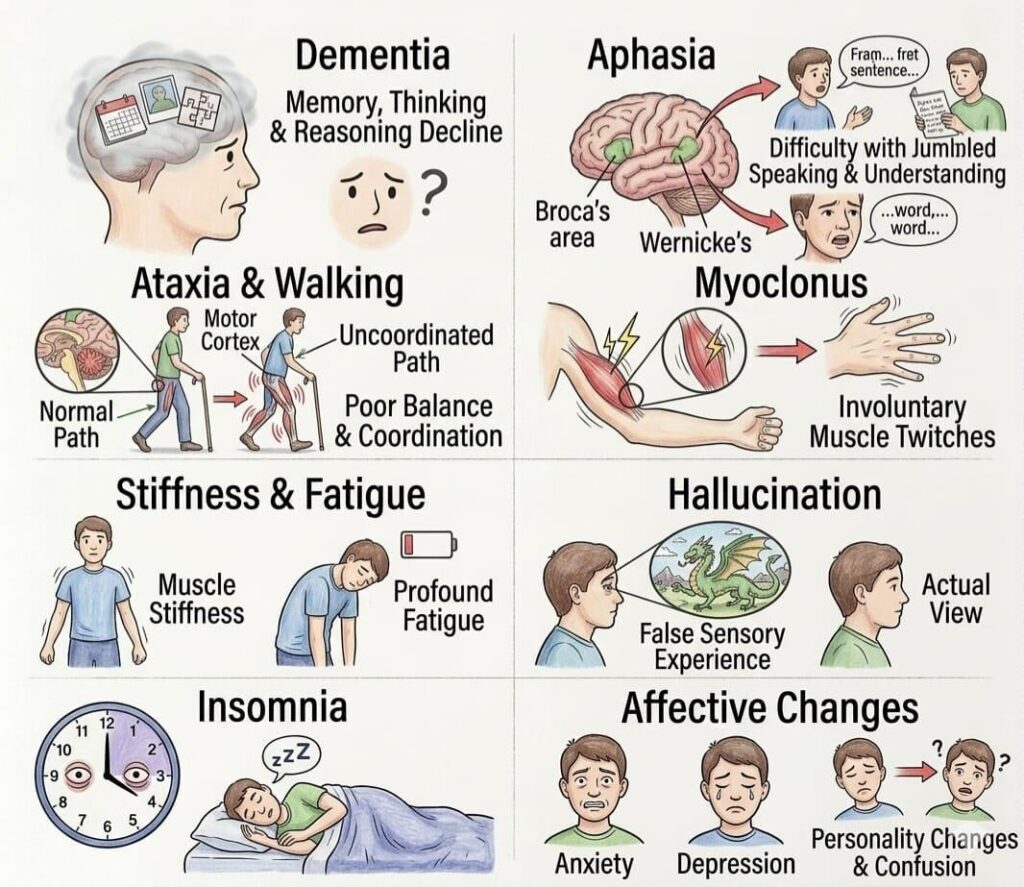
- Dementia (decline in mental abilities, such as memory, thinking and reasoning)
- Difficult walking
- Ataxia (lack of voluntary muscle control and coordination)
- Myoclonus (sudden brief involuntary muscle, jerks, or twitches)
- Hallucinations (false, sensory experiences that seem real, but occur without any actual external stimulus)
- Muscle stiffness
- Confusion
- Fatigue
- Aphasia (difficulty in the persons ability to speak, understand, read, or write)
- Insomnia
- Personality changes
- Anxiety
- Depression
The burning question-Is there a cure?
Unfortunately, at the moment there is no cure for prion diseases however there are certain medications that can help slow their progression. The medical care at the moment focuses on keeping affected people as safe and comfortable as possible while managing the symptoms.
1)Who to consult
All people with rapidly worsening dementia should immediately get a diagnosis with the nearest neurologist.
2)Supportive and palliative care
As aforementioned at the moment care centered towards prion diseases are mainly focused on slowing their progression and managing the symptoms to give the patient as comfortable of a time as possible.
3)New research and clinical trials
Recent advancements in medical research show lots of hope for future treatments. Scientists across the world are working to understand how abnormal prion proteins spread and how this process can be slowed. Modern research is shifting from just managing the symptoms to targeting the root of the disease process itself.
For example, one area of research is aiming to reduce the production of normal prion proteins so that there is less amount of it available to convert into harmful forms hence slowing disease progression.
There is also research being done to create monoclonal antibodies that can destroy abnormal prion proteins before their spread.
Along with that there is also research being done on the diagnostic aspect. Since earlier diagnosis could improve future treatment.
Although it may be many years before this research yields a cure for prion disease the research being done is actively also improving our understanding of other neurodegenerative condition such as Alzheimer’s and Parkinson’s which are also related to abnormal protein folding.
Prevention and Public health measures
There are a few measures that we can take as an individual and as a society to help prevent prion diseases.
- Proper cleaning and sterilisation of medical equipment
- Stricter regulations in the handling of meat and livestock
- People that have prion disease should not donate organs or tissues
So to summarise
Prion diseases are a rare type of neurological disorders that are unlike traditional infectious diseases. Unlike bacteria, viruses, or parasites, prion diseases are caused by misfolded proteins that can convert normal proteins into abnormal forms, setting off a chain reaction that gradually destroys brain tissue. This unique mechanism results in the characteristic spongiform changes seen in affected brains and leads to progressive neurological decline.
Although prion diseases are uncommon, their impact extends far beyond the relatively small number of people affected. The discovery of prions revolutionised our understanding of diseases by showing that proteins alone can act as deadly infectious agents. The ongoing research into prion diseases has provided valuable insights into protein misfolding, and contributed to our understanding of more common disorders such as Alzheimer’s and Parkinson’s.
The symptoms of prion diseases often begin subtly, before progressing rapidly to severe neurological impairment. Early recognition of warning signs and advances in diagnostic techniques have improved the ability of healthcare professionals to identify these conditions. At the same time, strict food safety regulations, medical sterilisation practices, and disease surveillance programs have significantly reduced the risk of transmission and strengthened public health protection.
While there is currently no cure for prion diseases, remarkable progress has been made in understanding their underlying biology. Scientists are researching innovative approaches including antibody therapies, gene-targeting treatments, and other strategies aimed at preventing the formation and spread of abnormal prion proteins. With continued research, international collaboration, and advances in medical technology, there is growing hope that the knowledge gained from studying these rare disorders will eventually lead not only to effective treatments for prion diseases but also to breakthroughs in the fight against many other neurodegenerative conditions.
References:
1. Johns Hopkins Medicine. Prion Diseases [Internet]. Baltimore (MD): Johns Hopkins Medicine. Available from: https://www.hopkinsmedicine.org/health/conditions-and-diseases/prion-diseases
2. Cleveland Clinic. Prion Disease: What It Is, Types, Causes, Symptoms & Treatment [Internet]. Cleveland (OH): Cleveland Clinic; 2024 Jan 2. Available from: https://my.clevelandclinic.org/health/diseases/prion-disease
3. Johnson RT. Prion diseases. Lancet Neurol. 2005 Oct;4(10):635-42. doi:10.1016/S1474-4422(05)70192-7.
4. Bellini P, Ruggiero F, Benedetti A, Cereda CW, Gobbi C, Bianco G, et al. Human prion disease: pathogenesis, diagnosis and public health. Viruses. 2026;18(2):216. doi:10.3390/v18020216.
5. Prion Disease | How does Prion Disease Happen [Internet]. YouTube; Available from:https://youtu.be/ZyvrjFcfHwQ?si=hcap0j0mkoqtcJ-1
6. Prion Disease Basics Clinical – 2023 Family Conference [Internet]. YouTube;Available from:https://youtu.be/U9RTjZP-pcA?si=RJ2k7rTp4cjEc7yH
7. Sastry AS, Bhat S. Essentials of Medical Microbiology. 4th ed. New Delhi: Jaypee Brothers Medical Publishers; 2023.