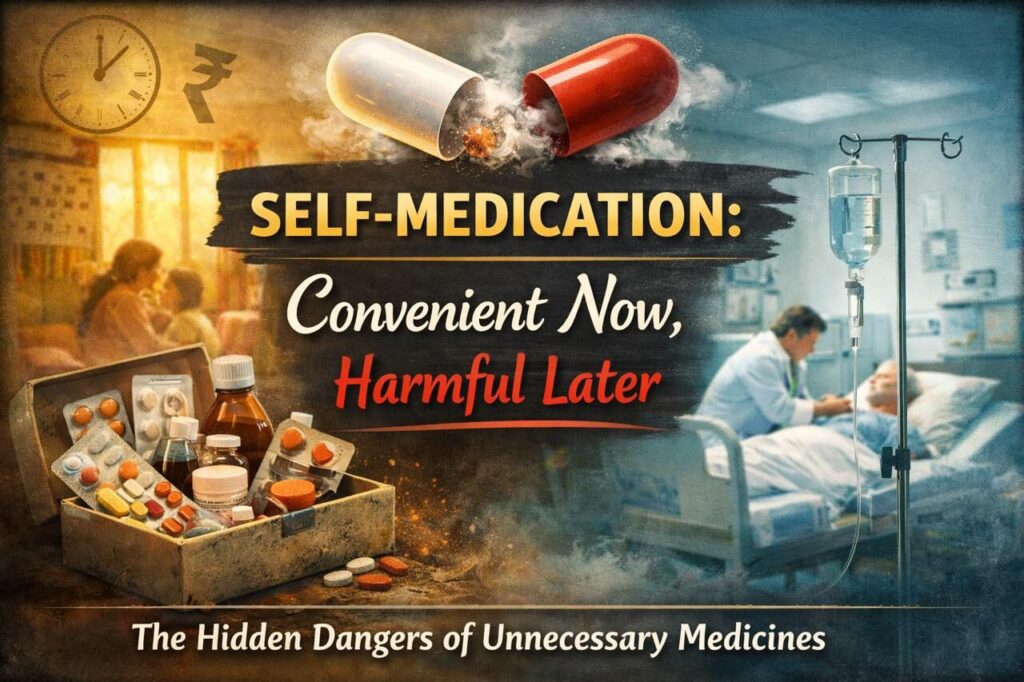
A sore throat! A mild fever!
Symptoms you’ve met before. Without hesitation, you take the leftover tablets from a previous prescription or make a quick stop at the pharmacy.
“No consultation, no questions, just relief on demand.”
Sounds familiar?
For many of us, this has become part of modern life. We juggle busy schedules, long commutes, deadlines, and the simple desire to “not let a small illness slow us down.” In a world where time feels expensive and pharmacies are far easier to access than healthcare professionals, self-medication has quietly become the norm.
Continue reading, to unhook the reality of self medication.
What is self medication?
Self-medication is treating the symptoms or illnesses on our own, without consulting a doctor. It includes using leftover medicines, buying drugs based on past prescriptions, or following advice from friends, family, or the internet.
Common examples are taking medicines for fever, cold, headache, or stomach issues.
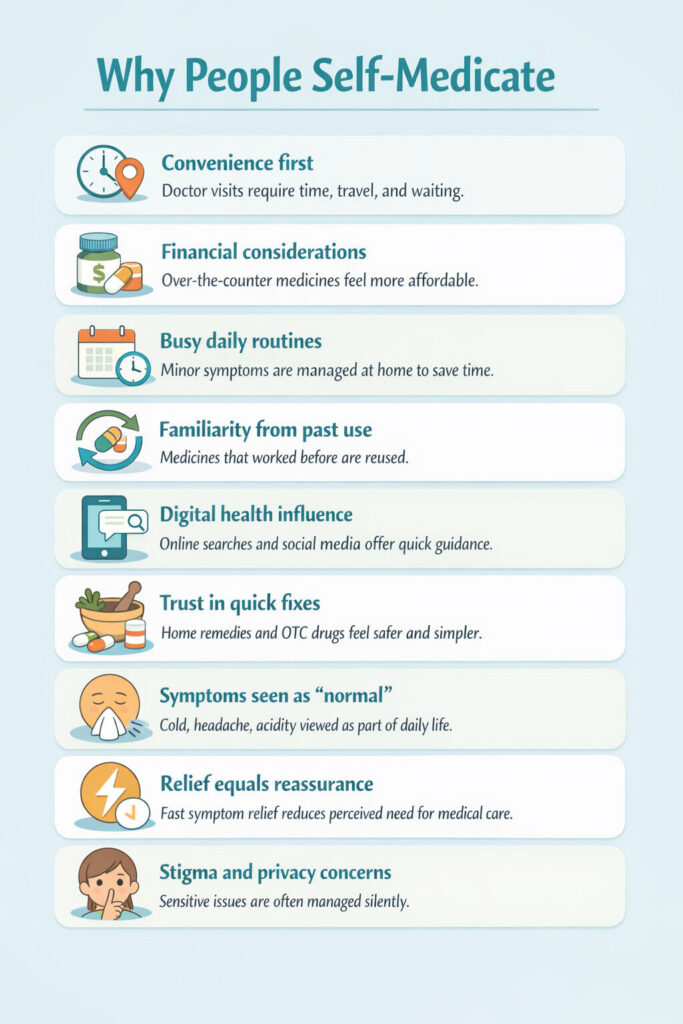
Why do people self medicate?
Most people self medicate not because of carelessness but due to the convenience. Visiting a doctor often means taking time out of their schedule, travelling, waiting and paying a hefty amount at the end with consultation fees and medicines prescribed.
Most people have busy schedules which restricts them from making a doctor’s visit and push them to manage symptoms at home especially when the symptoms seem minor.
For many individuals, cost is a real concern. The cost of buying a strip of tablets is comparatively cheaper.
But this habit mainly comes from past experience. If a medicine worked before, it is a natural tendency to reuse it.
In recent times, digital influence has added a new layer. Online searches, social media, and health apps give instant information, but not always accurate advice, leading to self-treatment.
Also many people prefer home remedies or quick fixes, sometimes avoiding doctors for conditions considered minor or “normal,” like mild fever, cold, or menstrual pain.
Common problems like cold, headache, body pain or acidity are seen as part of daily life, not reasons for medical attention. If relief comes quickly the need to consult a doctor feels unnecessary.
Finally, stigma plays a quiet but powerful role. Mental health concerns, sexual health issues, or chronic problems are often managed privately due to fear of judgment, leading people to treat themselves rather than seek help.
The danger of frequent dosing
Medicines are powerful in curing diseases but only if taken when required. When taken without need or taken for longer periods they do more harm than good.
Every medicine has its own side effects. Medicines mask warning signs. Pain disappears, fever is suppressed , symptoms are controlled but the underlying problem goes unnoticed.
There is a thin line between self care and misuse. When medicines are used repeatedly without understanding the cause of the illness, what starts as self care turns into misuse. What can seem like a quick fix carries huge risks at the shoulders of the ones self medicating themselves.
Real harm of self medication begins here.
Common ailments which are self treated
Some illnesses feel small and familiar. Fever, cough, headache, acidity – we have experienced them many times before. Because they seem minor, they are often treated casually.
But when we repeatedly silence symptoms without understanding their cause, temporary discomfort can quietly turn into long-term problems.
Fever, cough, common cold and sore throat
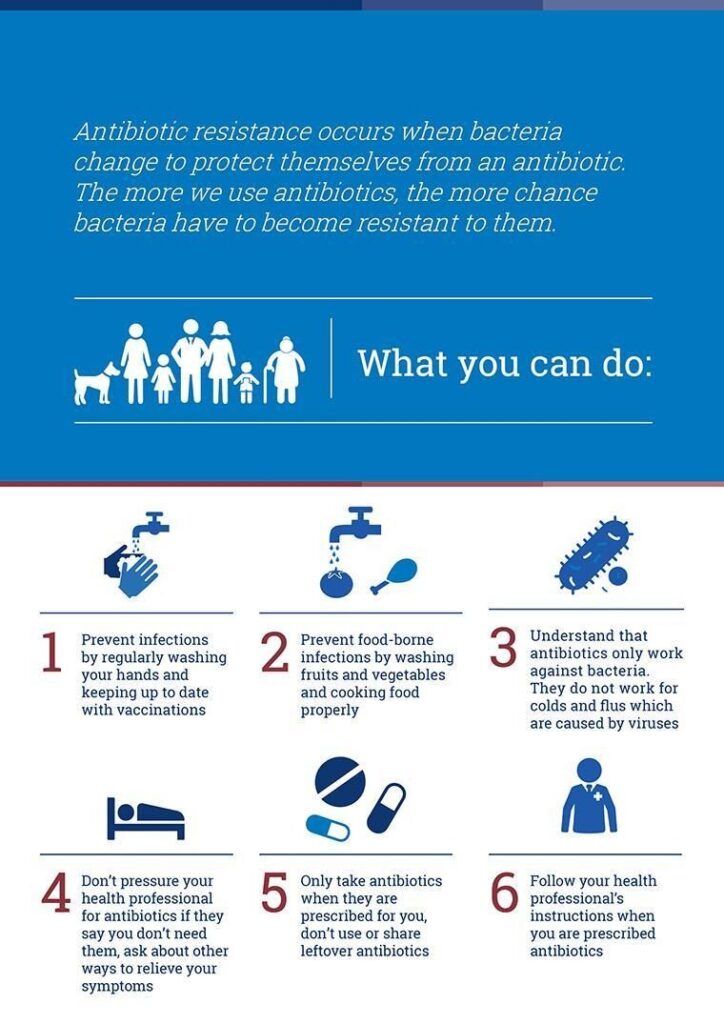
These are among the most common symptoms people experience. In most cases, they are caused by viruses. Yet antibiotics are frequently taken “just in case” or because they helped during a previous illness.
Antibiotics do not act against viruses. However, unnecessary use allows bacteria to adapt and develop resistance. When antibiotics are taken without indication — or when prescribed courses are not completed — stronger bacteria survive and multiply.
This gradually weakens the effectiveness of antibiotics. What should have been a short, self-limiting illness may later become an infection that is difficult to treat.
Antibiotic resistance is rising rapidly. If this continues, there will be a point where what seems a simple cure for common disease will vanish and we’ll be helpless against these tiny organisms which have turned stronger against us, that no weapon of ours can destroy them.
Similarly, medications for cold and allergies are often used repeatedly with every seasonal change. Though symptoms subside, frequent and prolonged use can reduce the drug’s effectiveness over time. Relief becomes temporary, and dependence begins to develop.
Body pain, joint pain and headache
Pain is the body’s signal that something needs attention. Yet it is often silenced immediately with painkillers.
While occasional use may be appropriate, routine and prolonged consumption can lead to liver and kidney damage. More importantly, the underlying cause of pain may be ignored.
The real issue could be a joint disorder, nerve problem, postural imbalance, or even a nutritional deficiency. By masking the pain without investigation, the condition progresses silently.
The symptom fades but the problem remains.
Digestive issues: acidity, constipation
Digestive complaints are commonly self-managed. Acidity may result from irregular meals or spicy food. Constipation is often linked to low fibre intake, poor hydration and sedentary lifestyle.
Instead of correcting these habits, many rely on antacids and laxatives for quick relief.
Acidity
Antacids reduce stomach acid and provide immediate comfort. However, prolonged use can lead to acid rebound, where the stomach produces excess acid once the effect wears off ,worsening the symptoms.
Magnesium-based antacids may cause diarrhea, while aluminium-based ones may cause constipation. Long-term overuse can interfere with calcium and vitamin B12 absorption, increasing the risk of bone weakness and deficiency.
What begins as occasional relief can gradually become dependence.
Constipation
Constipation is one of the most commonly self-treated conditions. Laxatives are easily available and often considered harmless.
Repeated use reduces bowel sensitivity, making spontaneous bowel movements difficult. As stools become harder to pass without medication, individuals may increase the dosage creating a vicious cycle.
Over time, this can worsen constipation and lead to dehydration, electrolyte imbalance, abdominal cramps and long-term bowel dysfunction.
Addressing diet, fiber intake, hydration and physical activity is far more effective than relying solely on medication.
Skin lightening and steroid misuse
The age old obsession with lighter skin has led to widespread misuse of topical steroids by many women. While these medications are meant for specific dermatological conditions, their potential side effect of skin lightening has contributed to inappropriate and prolonged use.
With long-term application, sudden discontinuation can cause redness, itching and flare-ups. Continuing the steroid provides temporary relief, making it difficult to stop. Eventually, this results in steroid dependence and chronic skin damage.
Here again, short-term comfort evolves into a long-term problem.
The Larger Picture
In all these situations, medicines perform exactly as expected, they reduce discomfort. But reducing discomfort is not the same as curing disease.
Self-medication often provides quick relief, but without proper evaluation, the underlying issue may persist or worsen. Antibiotic resistance, drug dependence, organ damage and chronic complications are not immediate, they develop slowly and silently.
Medicines are valuable when used appropriately under medical guidance. The problem is not the drug itself ,it is misuse.
Relief feels reassuring.
But comfort is not cure.
Irrational drug use v/s Responsible self care
Irrational drug use
This may bring temporary relief but can hide the real problem, and treatment later may become ineffective.
- Taking antibiotics for cold ,cough, viral fever without any prescription.
- Using medicines because it worked last time.
- Stopping medication as soon as one feels better.
- Taking multiple tablets without knowing the purpose of each of them.
- Continue using medicines like painkillers for months without follow up with the doctor.
Responsible self care
Responsible self care will support the body while it heals. It is not to replace medical treatment but to supplement and provide timely relief.
- Taking paracetamol for mild fever
- Taking ORS for loose motion to prevent dehydration
- Using emergency medications already prescribed by the doctor (e.g. for asthma attack)
An important part of self care is knowing when the symptoms are not improving and seeking doctors advice promptly.
Responsible self-care listens to the body.
Irrational drug use silences symptoms without understanding them.
Why consulting a doctor matters
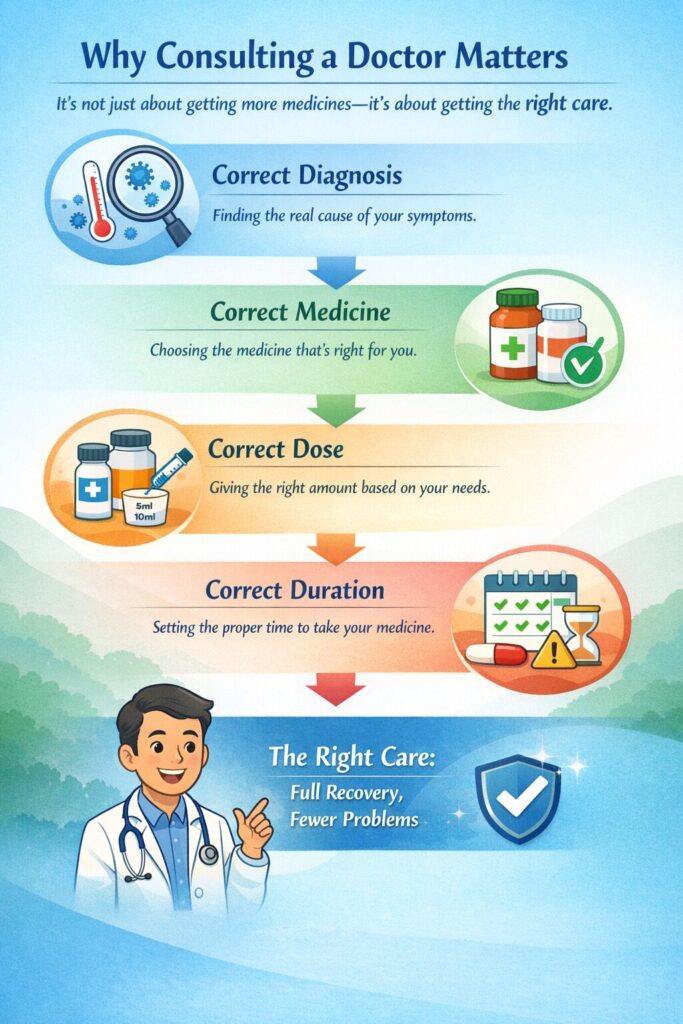
Seeing a doctor is not always about getting more medications. It is about getting the right care.
Correct diagnosis: Many illnesses have similar symptoms like fever, cough, pain and lethargy. A doctor’s examination helps identify the real cause, so treatment is not based on guesswork.
Correct medicine: Not every illness needs a medicine , and all medicines do not suit everyone. A doctor will choose which medicine is to be given to avoid unnecessary problem due to medicine itself.
Correct dose: The amount of medicine to be taken for e.g. x ml of syrup or x mg of medicine is decided by the doctor.
Taking too little medicine may not work, while taking too much can cause harm. Doctors prescribe the right dose based on age, weight, and health conditions.
Correct duration: Stopping medicines too early or taking them for too long can both be harmful. Doctors advise the right duration and following it will ensure proper recovery and prevent future problems.
Not every illness needs a medication
Many common problems such as a viral fever or mild cold will get better with rest,fluids, steam inhalation and most importantly with time as the body ‘s own defense mechanism is actively fighting against the infection.
Taking unnecessary medication may do more harm than good.
Sometimes reassurance is the treatment
Often, what patients need most is clarity about the illness to reduce fear. Proper reassurance from a doctor can prevent anxiety and avoid unnecessary medication.
Responsibility toward the community
The harm of repeated medication does not limit to the self but affects others too. Resistant infections spread quietly from home to hospital, from one patient to another. What once could be cured easily now demands stronger drugs, longer hospital stays and greater risk.
Doctors are forced to use the last line of antibiotics, treatment becomes expensive, recovery is slower and this strain is felt by the hospital. A simple infection can turn life threatening.
The elderly with decreased immunity are among the ones to suffer.
Conclusion
Convenience has a cost, the one that doesn’t show up immediately.
In our country, it’s common for familiar symptoms to be treated at home: a sore throat with antibiotics, a headache with painkillers, acidity with antacids. The reassurance feels instant, until it isn’t. With repeated use, antibiotics start losing their impact, painkillers demand higher doses, and medicines meant for symptom control begin to offer diminishing relief. What once worked easily, now whispers its failure quietly.
And by the time you finally seek medical advice, it’s harder, slower, and more complicated to treat.
Self-medicating may feel harmless in the moment, but its consequences are revealed slowly. It doesn’t just delay proper care, it fuels a bigger threat we are facing today: Antimicrobial Resistance (AMR). When medicines lose their ability to fight infections, the burden doesn’t fall on individuals alone, it affects families, communities, hospitals, and future generations.
Medicines save lives when used appropriately but misuse, especially without prescription or proper indication, fuels resistance, treatment failure, and harms not just the individual but the community as a whole.
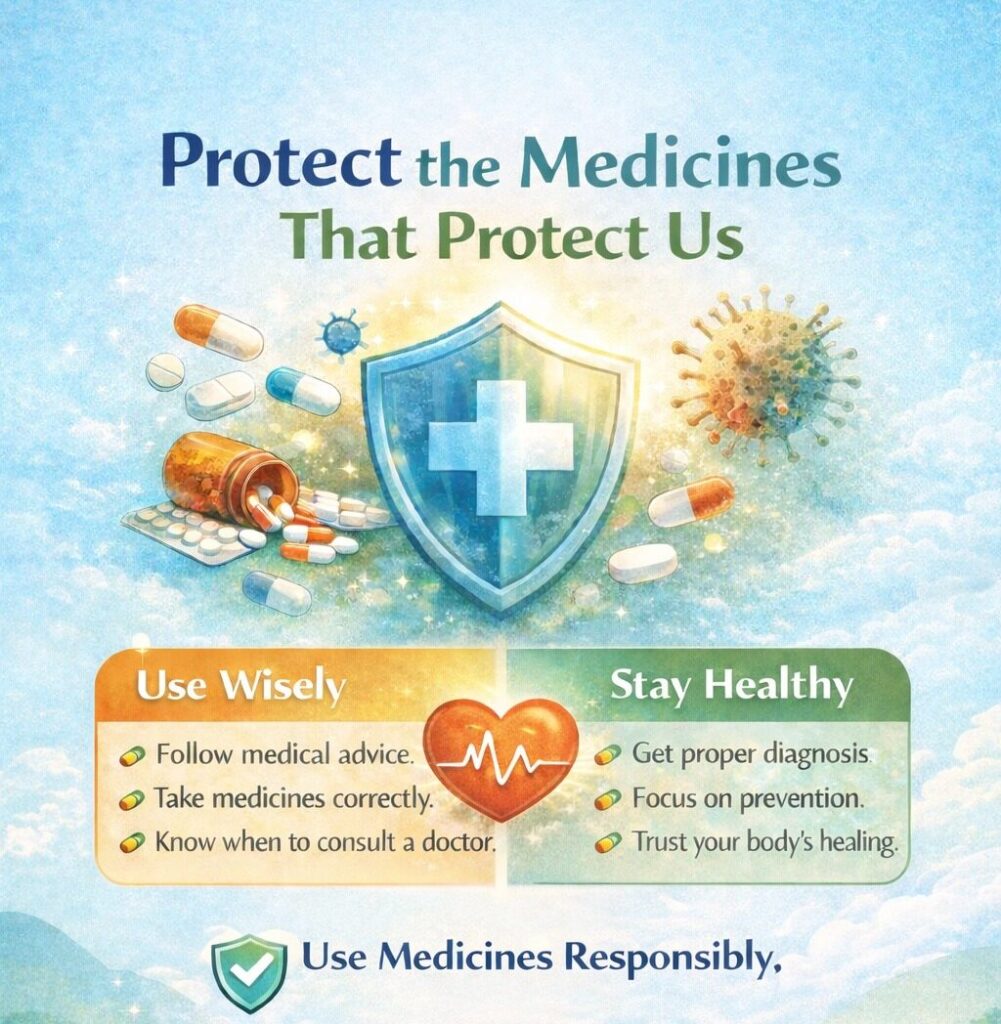
The question is no longer just about treating a sore throat or mild fever. It is about protecting the medicines that protect us.