

“Smart Supplementation: A Reality Check for Health-Conscious Indians”
Walk into any pharmacy in India today, and you’ll find shelves lined with promises—sharper focus, better sleep, stronger immunity, easier weight loss. The supplement aisle has become a temple of optimism, where hope comes in capsules and powders, each one suggesting that better health is just one purchase away.
Supplements have become necessary partly because we’ve traded away what our grandparents ate. The whole grains they ground at home have given way to polished white rice and maida that look cleaner but offer far less. We’ve moved indoors, away from the sun that our bodies need for vitamin D. And despite India’s rich vegetarian traditions, many of us now eat diets that are repetitive rather than diverse.
Vitamin D deficiency affects a large portion of the population despite abundant sunshine, partly due to indoor lifestyles and cultural clothing practices. Iron deficiency anemia is particularly prevalent among women and children. Vitamin B12 deficiency is common in vegetarians since it’s primarily found in animal products. Calcium intake often falls short, especially in regions with limited dairy consumption. Iodine deficiency persists in some areas despite salt fortification efforts.
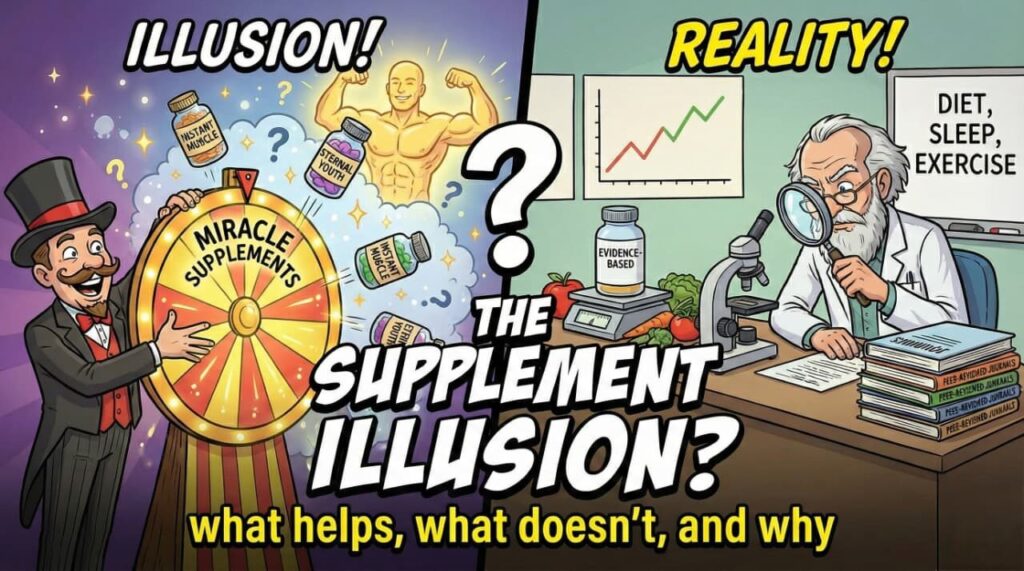
The supplement industry thrives on uncertainty. Sleek packaging and bold claims promise sharper minds, stronger bodies, and better health—often backed by little more than testimonials. Most people aren’t trying to hack their biology. They just want straight answers: what actually works, and what’s just expensive placebo. Supplements can’t outsmart basic physiology, and this guide aims to educate on that. The question isn’t whether supplements work. It’s which ones work, for whom, and under what circumstances. This distinction matters because the gap between marketing and reality has never been wider and/or more profitable.
This guide is written for healthy adults looking to improve health, performance, or recovery and not to treat disease, and not to chase miracles.
Supplements That Most People Benefit From and Are Hard to Replace With Food Alone
1. Fiber Supplements (Psyllium Husk, Inulin, PHGG)

Fiber deficiency is one of the most widespread and least discussed problems of modern diets. Highly processed, calorie-dense foods crowd out fruits, vegetables, and whole grains which ends up leaving digestion and metabolism to suffer quietly. Over time this results in major issues in the large intestine and also impacts quality of life
Soluble fiber improves bowel regularity, lowers LDL cholesterol, slows glucose absorption, and supports beneficial gut bacteria. These effects are not dramatic, but they are foundational. Whole foods remain the ideal source, but for many people, fiber supplements are the most practical way to meet daily requirements consistently. The long term benefits are immesurable and it is definitely your money’s worth.
Fiber is not a cleanse or a gut reset. It works precisely because it does nothing flashy — it supports basic physiology, day after day.
2. Creatine Monohydrate

Creatine is a natural substance made from amino acids and stored mainly in the muscles. During short and intense activities like sprinting or lifting weights, muscles use up ATP very quickly. Creatine helps by restoring ATP rapidly, allowing muscles to work slightly longer and recover faster between efforts. It does not act as a stimulant or create new energy. It only helps the body use its existing energy systems more efficiently. People who eat little or no meat often have lower creatine levels, so they may feel the effects of supplementation more clearly.
Beyond muscle, emerging research suggests cognitive benefits, particularly in individuals with low baseline creatine intake, such as vegetarians (which are a major part of the Indian population). Despite persistent myths, high-quality studies show no meaningful kidney damage in healthy individuals, and claims linking creatine to hair loss remain unsupported.
Creatine does not override biology. It simply allows the body and brain to perform closer to their natural limits, hence it deserves a spot here.
Supplements That Add Noticeable Benefit When Diet and Lifestyle Are Already Decent
3. Protein Powder (Whey, Casein, Plant-Based)

Protein powder is neither a shortcut nor a substitute for real food. It is a logistical tool. Active adults often need more protein than they realize, and many fail to meet consistent intake through meals alone, and this holds true especially for vegetarians. The average Indian diet is chronically deficient in protein.
Whey, casein, and well-formulated plant proteins provide a convenient, bioavailable way to bridge that gap. They do not improve a poor diet, but they do work when protein intake is otherwise insufficient. And it does a really good job at it.

When daily protein needs are already met through whole foods, supplementation adds little. When they are not, protein powder becomes one of the simplest and most reliable solutions available.
Supplements That Can Help in Specific Situations, but Aren’t Universally Useful
4. Vitamin D (Cholecalciferol)
Vitamin D is one of those nutrients that quietly does its job until it’s missing. It performs a very underrated function in our bodies: keeping our bones strong by helping the body absorb calcium. When vitamin D levels fall, bones slowly lose their strength. In children this shows up as rickets, in adults as bone pain, muscle weakness, and over time, osteoporosis and osteomalacia that causes fractures to occur easily.
In India, deficiency is far more common than most people assume. Despite abundant sunlight, modern lifestyles keep many indoors for most of the day. Darker skin reduces vitamin D production from sunlight, air pollution blocks UV rays, and our diets contain very few naturally rich or fortified sources.
This is why doctors commonly prescribe weekly or monthly high-dose vitamin D in India: it works, and it addresses a real, widespread problem. The trouble begins when vitamin D is treated like a miracle cure. Once levels are normal, taking more does not translate into extra health. Claims that vitamin D prevents heart disease, frequent infections, or acts as a general immunity booster are not strongly supported by consistent evidence, especially in people who are already sufficient. In such cases, supplementation mostly adds to expense and, in rare situations, risk from excess intake.
5. Magnesium
Can’t fall sleep? Can’t stay asleep? Anxious? Constantly tired? You’re not deficient in willpower, you’re (most likely) deficient in magnesium.

Severe magnesium deficiency is uncommon, but mild insufficiency is far more widespread, often going unnoticed. Modern diets, food processing, and chronic stress all contribute to lower magnesium intake, yet the symptoms are usually subtle: poor sleep, muscle tension, fatigue, or vague irritability rather than anything dramatic, and it is often confused with iron deficiency.
What magnesium does or doesn’t do depends largely on why it is taken and in what form. Magnesium is not a single supplement with uniform effects. For example, magnesium glycinate is better absorbed and gentler on the gut, and its calming properties may modestly improve sleep quality and relaxation in people who are tense, stressed, or mildly deficient. Magnesium citrate, on the other hand, draws water into the intestine and is far more useful as a laxative than as a general health supplement.
When magnesium is taken with a specific purpose improving sleep, easing muscle cramps, or relieving constipation it can be genuinely helpful. But when it is taken casually simply because it is seen as “healthy,” the benefits are usually minimal or unnoticeable. Like many supplements, magnesium works best when it fills a clear gap, not when it is added without a reason.
6. Probiotics

Probiotics are one of the most misunderstood supplements today, largely because they are marketed as something they are not. The idea that a capsule can “fix” your gut or permanently improve digestion sounds appealing, but the human gut does not work that way. Probiotics are not magic seeds that move in and settle forever. Their effects depend on the exact strain, the reason they are taken, and how long they are used, and even then, the changes are usually temporary.
In certain situations, probiotics do help. Some strains can reduce diarrhea after a course of antibiotics, and a few can ease symptoms in specific subtypes of irritable bowel syndrome. In these cases, they act more like short-term support than a lasting solution. Once the supplement is stopped, the added bacteria generally disappear, and the gut returns to its usual balance. This is why many people notice little to no long-term difference despite taking probiotics for months.
For everyday “gut health” or routine optimization, probiotics are often unnecessary. The gut microbiome is shaped far more by daily habits than by capsules. What you eat consistently especially fiber-rich foods like vegetables, fruits, whole grains, and traditional fermented foods has a deeper and more lasting influence than any short-term supplement. Yet probiotics are heavily promoted as essential for everyone, when in reality their benefits are narrow and situation-dependent.
7. Melatonin gummies:

They are often sold as an easy answer to sleep problems, but melatonin itself is widely misunderstood. It is not a sleeping pill that knocks you out. Melatonin works more like a time signal, telling your brain when it is night. Its real power lies in shifting the body clock, not forcing sleep. That is why it can be genuinely useful for jet lag, night-shift workers, or people whose sleep cycle is naturally delayed.
For healthy adults whose body clock is already aligned, melatonin does much less. In typical insomnia, where stress, habits, or overstimulation are the real issues, melatonin offers only modest benefit. It may help you fall asleep a little earlier, but it does not reliably improve sleep depth or quality.
Gummy formulations make this problem worse. Dosing in gummies is often inconsistent, absorption can vary, and adding sugar right before bed works against good sleep hygiene. They are designed to be appealing, not precise. When melatonin is actually indicated, small doses from pharmaceutical-grade tablets work better, are more predictable, and avoid unnecessary extras.
8. Electrolytes
Electrolyte supplements are genuinely useful in certain situations where the body loses large amounts of fluid and salts. During prolonged endurance exercise, intense sweating, severe dehydration, or episodes of vomiting and diarrhea, electrolytes like sodium and potassium are lost faster than they can be replaced by plain water. In these cases, electrolyte solutions help the body rehydrate properly and restore balance.
Outside of these scenarios, routine use offers little benefit. In healthy individuals, the kidneys are extremely good at maintaining electrolyte balance on their own. With a normal diet and regular water intake, the body already gets what it needs. Using electrolyte drinks or powders every day often adds unnecessary sugars or salts without improving health. For most people, electrolytes are a tool for specific situations, not something the body needs on a daily basis.
9.Omega-3 Fatty Acids (EPA/DHA)

Omega-3 supplements are often taken with the hope that they offer wide-ranging protection for the heart. The promise sounds simple: a capsule a day for better cardiovascular health. In reality, the benefits are more limited than many people expect. Large studies in generally healthy populations have shown mixed and inconsistent effects on heart attacks, strokes, or overall mortality. For most people, omega-3 supplements do not act as a guaranteed shield for the heart.
Where they do have a clearer role is more specific. Omega-3s reliably lower triglyceride levels, and they can be useful for people who rarely or never eat fatty fish. In these cases, supplements help fill a genuine dietary gap rather than adding something extra to an already adequate intake.
Still, supplements are not the ideal starting point. Eating whole fish provides omega-3s in a natural form, along with protein and other nutrients that work together in ways capsules cannot replicate. Regular fish consumption has more consistent links with cardiovascular benefits than supplementation alone.
Supplements With Limited Evidence and Poor Cost–Benefit for Most People
10. Multivitamins

Multivitamins persist largely because they feel reassuring. However, large studies show no mortality benefit in healthy populations. They often promote nutritional complacency and carry a real risk of excessive intake of fat-soluble vitamins, which accumulate in the body.
Their role is limited to specific clinical situations and should not be considered daily health insurance.
11. L-Glutamine

Glutamine is often marketed as a muscle-building essential, but in healthy people who already consume enough protein, it rarely delivers anything noticeable. The body can synthesize glutamine on its own, and a normal high-protein diet already provides more than enough to support muscle repair and performance. Large studies have repeatedly shown no meaningful improvement in strength, muscle growth, or exercise capacity from routine supplementation.
Where glutamine does have value is in very specific situations. During severe illness, trauma, burns, or other highly catabolic states, the body’s demand for glutamine can exceed its ability to produce it. In these settings, supplementation may support recovery and gut integrity. Outside of these clinical contexts, its role is limited.
12. Berberine

Berberine is frequently promoted as a “natural Ozempic,” a comparison that sounds impressive but falls apart under closer look. While berberine does have some metabolic effects such as modest improvements in blood sugar and insulin sensitivity, these effects are small and inconsistent when compared to established medical treatments. They are nowhere near the potency, reliability, or outcome-driven benefits of modern pharmacotherapy used for diabetes or weight management. It is not a replacement for a well researched powerful prescription drug, the hype does not live up to its actual benefit.
Supplements That Are Largely Marketing-Driven and Unlikely to Deliver Real Results
13.Detox Teas:

Detox teas sell the idea that the body needs help “cleansing” itself, but this is a misunderstanding of how human physiology works. Most detox teas work through mild laxatives or diuretics, which simply increase bowel movements and urine output. The quick drop on the weighing scale comes from loss of water and stool, not from removal of toxins or body fat. In reality, detoxification is already handled continuously and efficiently by the liver and kidneys. No tea can improve this process in a meaningful way, and repeated use often leads to dehydration rather than health.
Regulation, Reality, and Safety
One uncomfortable truth often gets ignored: the supplement industry lives in a regulatory grey zone. Unlike medicines, quality control is frequently optional rather than enforced. Labels can look confident and scientific while hiding fillers, incorrect dosages, or even contaminants. What’s printed on the front is marketing, not proof. Third-party testing does improve reliability, but it raises the odds; it does not guarantee purity or accuracy.
The placebo effect also deserves more honesty. If someone feels better after taking a supplement, that experience is real. But feeling reassured is not the same as a true biological improvement. Belief can change perception, mood, and even symptoms, but it does not mean the supplement is fixing anything underneath.
There is also a tendency to equate “natural” with “safe,” which is misleading. Supplements are biologically active substances that are processed by the liver and kidneys, just like drugs. Most healthy adults tolerate them without issue, but pregnancy, existing medical conditions, or the use of prescription medications change the risk entirely. In those situations, casual supplementation can quietly become harmful.
Supplements are best viewed as tools, not solutions. Used selectively, for clear reasons, they can add value. Treated as magic in a loosely regulated market, they are unnecessary at best and risky at worst.
Please remember to look out for any of the above discussed symptoms, and reach out to your doctor if you’re expecting anything familiar. A consultation and prescription by your doctor before using your desired supplements is always a smart move.