
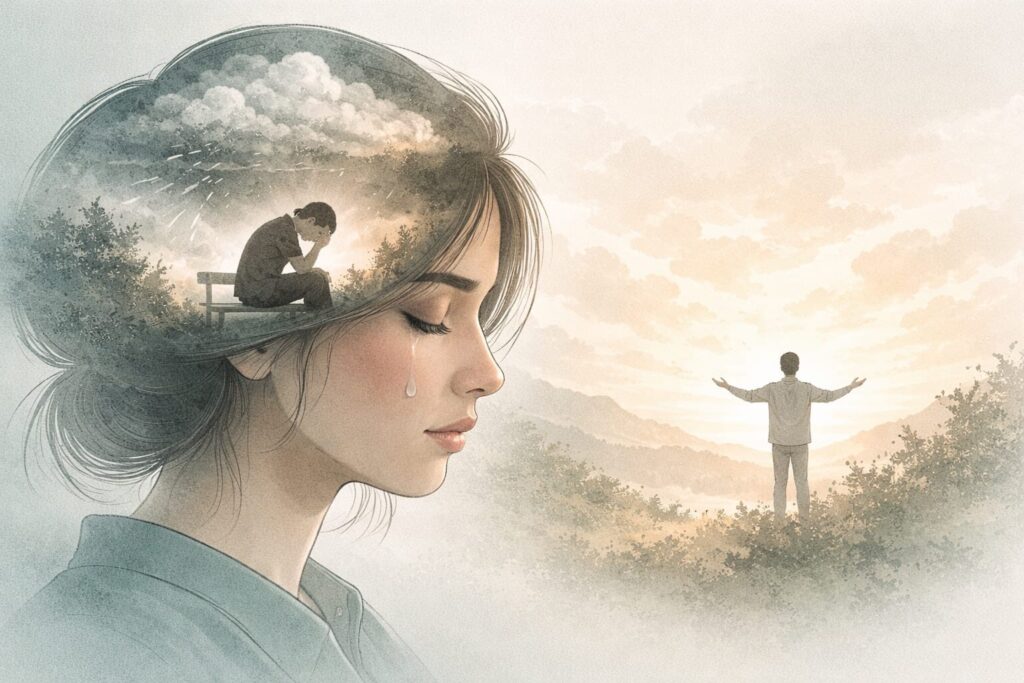
Depression is a room with no windows,
A place where the sun forgets your name.
You wander inside your own silence,
Looking for light that never came.
Yet somewhere beneath the aching shadows,
A tiny spark refuses to die.
If you listen close, it whispers softly—
“Hold on… you were made to touch the sky.”
Depression- The silent storm inside
Imagine this: You wake up one morning and it feels like someone put an invisible 20-kg backpack on your chest. You try to get out of bed, but the world feels heavier. Even brushing your teeth feels like a task meant for superheroes. People around you say, “Just cheer up” or “Why are you overthinking so much?”. But inside, it feels like you’re drowning in slow motion—while everyone else is breathing just fine.
This is what living with depression can feel like. It is not “weakness,” “overthinking,” or “drama.” It is a real medical condition that affects how a person thinks, feels, and lives.
According to WHO, depression is a common mental disorder characterized by a persistently low mood or a loss of interest or pleasure in normal daily activities. This state lasts most of the day, nearly every day for at least two weeks.
In today’s world, depression is a very common mental disorder that affects millions of people every year, Yet our understanding of depression remains limited to ‘sadness’ whereas, it actually is way more than that. In this article, we’ll understand what depression is, why it happens, and how we can help ourselves and others through it.
So, if you have ever felt this way, this article is for you. If someone you love feels this way, this article is for you too.
Am I just sad?
Don’t we all know what it’s like to feel sad? A rainy Monday, a disappointment at work, or the loss of a loved one—these moments bring natural, temporary sadness. But Clinical Depression is fundamentally different. It is not a mood; it is a complex medical condition that settles in like a thick, relentless fog, obscuring your ability to feel joy, motivation, and sometimes, even hope.
So, to understand depression, we first need to understand that grief and depression are not the same-
| GRIEF | DEPRESSION |
| Feelings of emptiness especially due to theloss of a loved one. If these feelings persist even after 6 months, grief can take the form of depression. | Persistent low mood and inability to be happy. |
| Gets better over time- maybe in some weeks or months. | Doesn’t get better with time. |
| The person can feel positive emotions even in pain. | The person feels minimal or no positive emotions. |
| The person keeps recollecting the things that made him sad. | The person ruminates over pessimistic and self-critical things. |
| The self-esteem of the person remains intact. | The self-esteem of the person takes a major hit. |
| The person thinks of death as a way to join the deceased person in case of death of a loved one. | The person thinks of death as a way to end his suffering. |
The signs we often overlook- The Symptom Checklist
It is often thought that depression shows up as tears. But, it is astonishing to know that this is far from reality.
A psychological study once conducted revealed that nearly 5.7% of people who suffer from depression were deemed “fine” by their friends or family. They could function properly as if nothing was wrong but their mask fell when they were alone.
Depression can show up in different forms in different people and it is necessary to be aware of the signs that people often try to hide behind a mask-
- Persistent low mood
- Decreased interest in activities that once seemed exciting
- Weight changes – generally loss of weight and loss of appetite
- Disturbed sleep – Insomnia/increased sleep (Atypical Depression)
- Feeling tired even after resting
- Difficulty concentrating
- Withdrawing from people close to self
- Feeling irritated or restless (Premenstrual Depression)
- A constant sense of guilt
- Manifestations as physical symptoms like headache
- Feelings of worthlessness, helplessness or hopelessness
- Feeling overwhelmed
- Slowed thinking, speaking or body movements
If you or anyone you know wants to understand if they might have symptoms of depression, go through this Checklist and check if you might have symptoms of depression-
What is wrong with me?
Whenever something goes wrong with us, the first question that comes to mind is – “what is wrong with me?”. It is especially no better in the tabooed topic of depression.
But having depression is no sign that your life has ended or that it cannot get better again. It can happen to anyone at any point of time.
A lot of factors can play a role in making a person susceptible to depression-
- Altered brain chemistry– Our brain is the control center of the whole body. If something goes wrong with the brain, the whole system crashes. Imagine your mood is controlled by a vast, complex network of roads inside your brain. The “cars” on these roads are hormones, which are chemicals that produce emotions.In a healthy brain, these cars speed smoothly across the junctions, transmitting signals of pleasure, focus, and energy.
In a depressed brain, one of two things often happens:
1. Too Few Cars: The brain isn’t producing enough of these vital chemicals.
2. A Faulty Sensor: The receptors (the parking spots for the cars) are blocked or inefficient, meaning the existing chemicals can’t deliver their message effectively.
The result is a communication breakdown. The brain can’t broadcast the “all clear” message of well-being, leading to the pervasive feelings of emptiness, fatigue, and lack of interest that characterises depression.
- Genetics: Depression has a tendency to run in families. Statistics say that there is a 17-75% chance of a person suffering from depression if a family member suffers from the same.
- Stressful life events: Everyone of us has a threshold for handling the lemons that life throws our way. But sometimes the problems pile up, such that a person starts to lose hope falling into depression. Chronic stress, events like death of a loved one, marriage problems, problematic childhood experiences, etc. very often, leads to depression.
- Personality: Everyone of us is unique. We all have traits that make us different. But sometimes, some particular traits of a person can make him more susceptible to depression. Like people who are- perfectionists, sensitive, over thinkers, self critical or introverted.
- Hormones: Hormones are the chemical messengers of our body. Healthy working of our body is controlled by them. If there is anything wrong with the levels of these chemicals in our body, our system goes haywire.
- Social factors– Lack of support, loneliness, toxic relationships, or constant criticism can slowly drain your emotional battery and can lead to the rabbit hole of depression.
- Medical illnesses: We all have been through troublesome illnesses in our life. When you’re ill, lying in bed all day, feeling drained and unable to do anything, you feel hopeless. Now imagine this for someone who has a chronic illness. How hopeless would he feel? It is reported that it is very common for people with chronic illnesses like diabetes, asthma, cancer, PCOS, etc. to fall into depression. Undiagnosed hypothyroidism is also a major cause of depression in people.
- Substance use: A lot of people, in hopes of finding a temporary freedom from their own thoughts, turn to substances like alcohol, cigarettes or drugs. At the time, it may feel wonderful. But, these substances eat a person from inside, altering their brain chemistry, making them susceptible to depression.
The lies we’ve been told about depression
Everyone around us has some or the other opinion about depression. But that doesn’t make everything we hear right. Depression has a lot of myths surrounding it-
| MYTH | REALITY |
| Depression is not a real illness | It is a very serious medical condition and one of the top causes for disability. It must not be confused with sadness. |
| Only women can get depressed | Men are just as likely to suffer from depression. But depression in men tends to go undiagnosed as they are less likely to talk about their feelings. Some men tend to get irritated or reckless when depressed. |
| Only those who are weak get it | Depression can affect anyone — regardless of age, gender, background, or social status. |
| Help means drug for life | Even talk therapy works fine for mild to moderate depression. But even if antidepressants are prescribed, the doctor will help you determine when to stop them. |
| Depression is a part of ageing | People can get depression while ageing, but it is not necessary. |
| Talking can make things worse | There’s evidence that guided discussions with a professional can make things much better. |
| Teens tend to be unhappy or moody by nature | Although many teens are moody and argumentative, prolonged sadness is not normal. Statistics reveal that nearly 1 in 11 teenagers suffer from depression. |
| If a family member has it, you’ll get it too | Even though genetics play a 50% role in depression, it is not the only cause. So yes, it can make you vulnerable but not a definitive patient. |
| if a person just stays busy or socializes, they’ll get better | Depression often disrupts motivation and energy making simple actions like ‘getting out’ difficult. |
| Therapy or treatment won’t help, depression is lifelong | While depression may be recurrent, many people respond very well to treatment and live fulfilling lives. |
Is it only me?
Even though it feels that you are the only one suffering, statistics reveal that a staggering 21 million adults have had a depressive episode in the U.S.
An estimated 4% of the population of the world experience depression including 5.7% of adults and 5.9% of the elderly. Approximately 332 million people in the world have depression.
In India, the National Mental Health Survey revealed that nearly 15% Indians needed help for a mental health issue and that 1 in 20 Indians suffers from depression.
A silent cry for help
Depression is such a common problem nowadays, still very few of us actually know when someone is crying out for help. Depression isn’t loud, it’s a silent scream which doesn’t reach an ear in time.
Let us answer- “How would I know?” And maybe save a life by knowing the signs various age groups can show-
- Children– anxious or cranky, refusal to go to school, sulk, be restless
- Young adults/teens– low self esteem, anxiety, eating disorder, attention deficit, easily frustrated, having a negative view of life
- Elderly– sadness, grief, lack of emotions, have another medical condition, memory problems
- Middle aged adults– insomnia, stomach problems like diarrhoea
The most important warning sign of depression is when a person stops being sad. Astonishing, right?
Sometimes, the most painful struggles become the quietest. A person who has been weighed down by depression for a long time may suddenly seem calm, light, or unusually positive. They might say, “I’m okay now,” or “You don’t need to worry about me.” To others, it can look like healing — but inside, it may be exhaustion. As if they’ve grown too tired to keep explaining their pain. Small changes can appear: a gentle withdrawal, unexpected goodbyes, giving things away, or making peace in subtle ways. These moments are not always cries for help — they are often whispers. And whispers, too, deserve to be heard with care, closeness, and compassion. Such a drastic change must be followed by immediate help.
Is this forever?
They say there is a light at the end of every tunnel. Even though depression may seem like a world with no sunshine anywhere, the light that cuts through this darkness lies within you. Treatment of depression is very much possible-
- Acceptance- First of all, accept that something is wrong with me. Depression tends to go untreated primarily because people don’t believe that a problem like this can happen to them.
- Try to do a physical activity for at least 30 minutes every day.
- Stay connected to your friends and family
- Talk about your feelings to anyone you trust- therapist, friends or family.
- Stick to regular eating and eating habits
- Avoid alcohol and smoking as it can worsen your symptoms
- Get yourself checked by a healthcare professional and diligently follow the treatment plan. The treatment plan can include- 1. Medications- many antidepressants are available, which if taken under the guidance of a doctor, can help. 2.Psychotherapy- It sounds scary right? Don’t worry. It’s just talking about your feelings and worries to a medical professional. This helps improve the overall well being of a person.
- If someone you know is suffering from depression, you can help them by offering support and encouragement. Invite them out for walks or outings.
YOU ARE NOT ALONE
“Even after the darkest nights, there comes a sunrise”
Depression is not a sign that you are weak, it’s a sign that you have been strong for too long. It lies and tells you that you are a burden, that the world is better off without you and that things would never change, but these are not the truths. Depression is a very real but also a treatable condition. But the treatment comes with one condition- you must want to get better. Depression does not define you. It is a part of your story. It is just a chapter and chapters can be rewritten.
Remember, If your mind is tired, let yourself rest. If your soul feels heavy, let someone help you carry the weight. If your heart feels lost, know that hope exists
You matter. Your story matters. Your healing matters.