

Open a can of diet soda and listen. The hiss, the fizz, the tiny crackling sound like rain on hot pavement. It feels light, playful, almost harmless. Zero calories. Zero sugar. Zero guilt. You may have even told yourself, this is practically water with personality.
Now the uncomfortable question. Is that personality doing something inside your body?
Most debates about diet soda zoom straight toward artificial sweeteners and cancer labels. But something else is present in every can, every bottle, every energy drink and “sparkling” anything. Carbonation. The bubbles. The fizz. The thing that makes your eyes water when you accidentally laugh mid-sip.
Carbonation is not just an aesthetic feature or a marketing trick. Those bubbles are dissolved carbon dioxide entering your mouth, your stomach, your bloodstream and briefly your physiology. Diet soda is not simply sugary soda minus sugar. It is an acidic, carbonated liquid with mechanical, chemical and sometimes hormonal effects.
This is not a horror story. Occasional diet soda will not destroy your health or make your skeleton evaporate. But if you are drinking it daily or you are curious about what the fizz really does, it is worth taking a closer look.
What carbonation actually is?
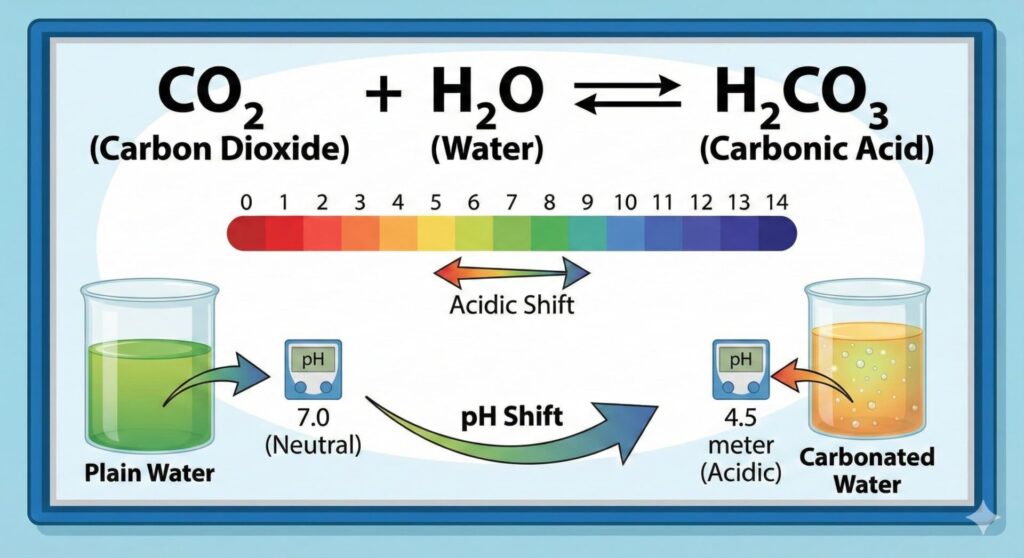
Carbonation is carbon dioxide gas dissolved into water under pressure. Imagine shaking a bottle not as a prank, but as a physics demonstration. When you open it, the pressure drops and the gas escapes in a rush of bubbles. Inside the drink and briefly inside your body, CO₂ mixes with water to form carbonic acid. It is a weak acid, yes, but it is still acid.
So when you drink diet soda, three processes happen at once. Carbonic acid lowers pH in your mouth. Gas expands in your stomach. And part of the CO₂ eventually diffuses into your blood and is exhaled through your lungs.
The bubbles do not simply vanish because the can is empty. They have already been in contact with your enamel (the hard, outermost layer of teeth) , your esophagus and your stomach wall. Carbonation therefore is not passive. It is biologically active.
If you have ever chugged soda and immediately belched in a way you hope your future employer never witnesses, your stomach was performing a basic physics experiment.
Carbonation versus sweeteners versus acids
Most research about soda lumps everything together. Sweeteners, flavorings, acids, caffeine, carbonation. When something bad is found, “soda” gets blamed as a monolithic villain. But not all ingredients do the same thing.
Carbonation belongs primarily to the CO₂ bubbles. Acidity largely comes from carbonic acid, phosphoric acid and citric acid. Sweetness is from aspartame, sucralose or other non-nutritive sweeteners.
So enamel erosion is mainly due to low pH. Appetite hormone changes can be related to carbonation. Bone mineral loss, where it exists, is linked more to phosphoric acid and caffeine.
That means carbonated water and diet cola do not behave identically inside you. Yet TikTok nutrition arguments rarely mention that nuance.
Gastrointestinal effects: bloating, reflux and that mysterious full feeling
Let us start with the upper gastrointestinal tract, because this is where carbonation makes its presence most obvious.
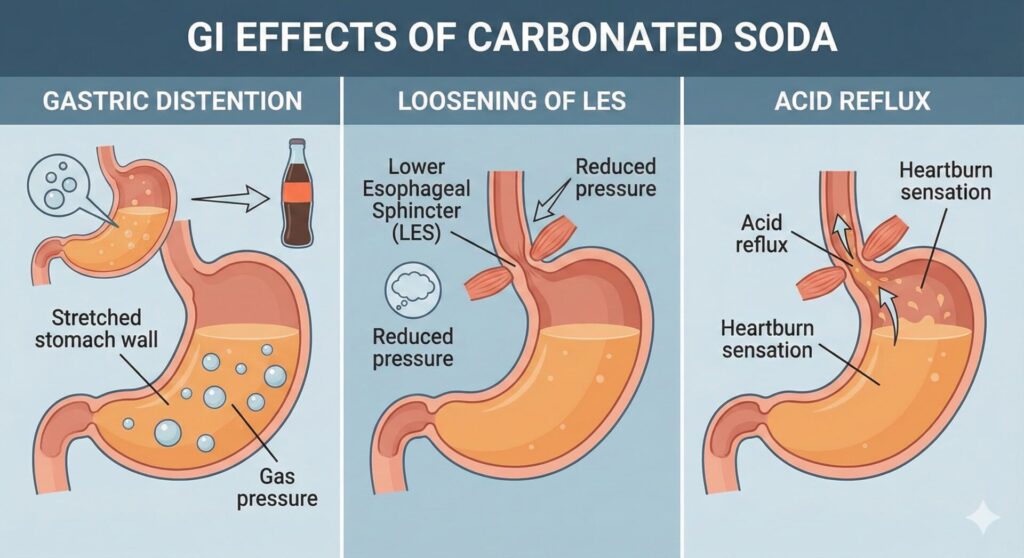
When you drink a fizzy beverage, CO₂ expands in your stomach. The stomach wall stretches. This stretch creates sensations of fullness, pressure and sometimes discomfort. You may call it bloating. A gastroenterologist calls it gastric distension. Your friend simply laughs when you burp loudly during a movie.
That same distension can temporarily loosen the lower esophageal sphincter, the valve that normally prevents stomach contents from traveling upward. Studies using manometry have shown that carbonated drinks can briefly reduce sphincter pressure and increase transient relaxations. Translation: the valve becomes slightly lazier for a few minutes. That is one reason why people with reflux often say soda “burns on the way back up”.
Curiously, some research finds that reflux symptoms rise even when acid exposure objectively does not. So carbonation increases the sensation of reflux and fullness, even if measurable reflux episodes are not dramatically higher. In other words, what you feel is real, even if the meter is unimpressed.
Now here is the twist. In people with functional dyspepsia and constipation, carbonated mineral water has been shown to improve symptoms. That same gas expansion that annoys some people helps gastric accommodation and motility in others.
So ask yourself. Does soda make you burp, relieve discomfort or aggravate it? Your answer tells you more than any headline.
Appetite hormones and why the bubbles may make you hungrier
One of the strangest and most fascinating findings about carbonation is its relationship with hunger hormones. Experimental studies report that carbonation can raise ghrelin levels. Ghrelin is the “hungry now” signal your stomach sends to your brain. It is the hormone whispering that you deserve a pizza at 2 am because you studied hard today.
In animal studies, rats drinking carbonated beverages showed:
- greater ghrelin secretion
- higher food intake
- more frequent feeding
- increased body weight
- more visceral fat
Human experiments echo the pattern. People drinking carbonated beverages report more hunger compared with degassed beverages. These results do not mean carbonation will force you to gain weight. They do mean carbonation may press the hunger accelerator slightly, especially if you drink diet soda before meals or throughout the day.
A slightly uncomfortable question:
Have you ever eaten more snacks when soda was present, despite the drink itself having zero calories?
Your answer again is the data before you.
Teeth: erosion, not just cavities
Dentists do not hate soda only because of sugar. They hate acidity.
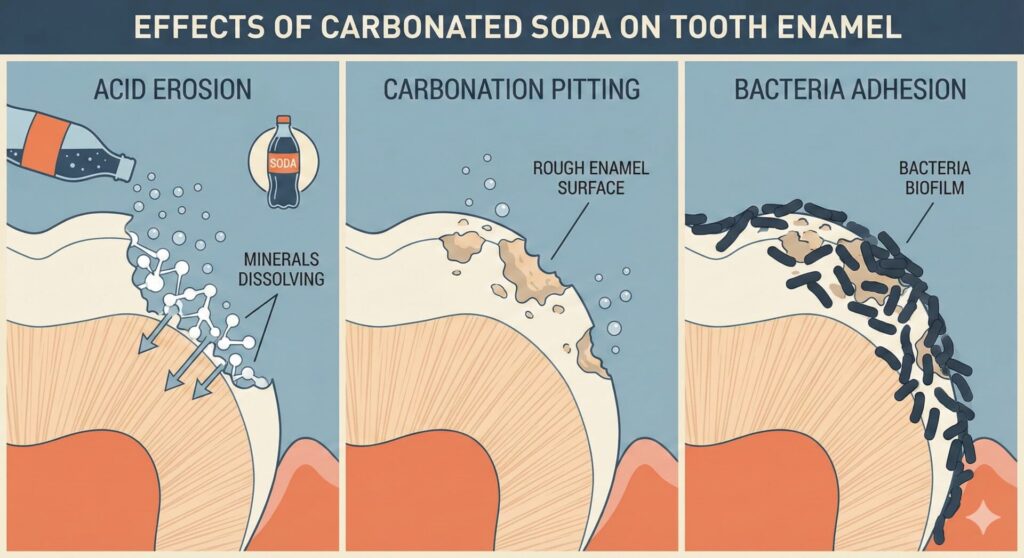
Teeth are made of mineral. Acid dissolves mineral. This is not philosophy, it is chemistry. Sugar feeds bacteria, which produce acid and cause cavities. Carbonation and added acids lower pH directly and cause erosion. Diet soda therefore can avoid caries but still damage enamel.
Carbonated water has been shown to soften enamel more than still water. Sugar-free soft drinks can roughen dentin surfaces and encourage bacterial adhesion. Repeated acidity weakens the tooth surface even if sugar never enters the picture.
If you are sipping diet soda all day rather than drinking it at once, your enamel is bathing in acid repeatedly. That habit matters more than the brand label.
Ask yourself another question. Do you rinse your mouth afterward or brush immediately? Because brushing on softened enamel can actually scrape away more.
Bones, rumors and what carbonation is probably not guilty of
A persistent myth claims carbonation directly sucks calcium out of bones. If that sounds like science fiction, that is because it partly is.
Studies linking cola intake with low bone mineral density show two likely culprits. Caffeine promoting calcium loss in urine and phosphoric acid altering calcium balance. Another factor is simply displacement. Teenagers replacing milk with soda reduce calcium intake without realizing it.
Carbonation alone does not consistently show independent bone harm. Blaming bubbles ignores lifestyle. Screen time instead of weight-bearing exercise. Midnight gaming instead of sleep. Soda instead of milk. The skeleton responds to the whole pattern, not only the fizz.
Bladder and kidneys: irritation more than infection
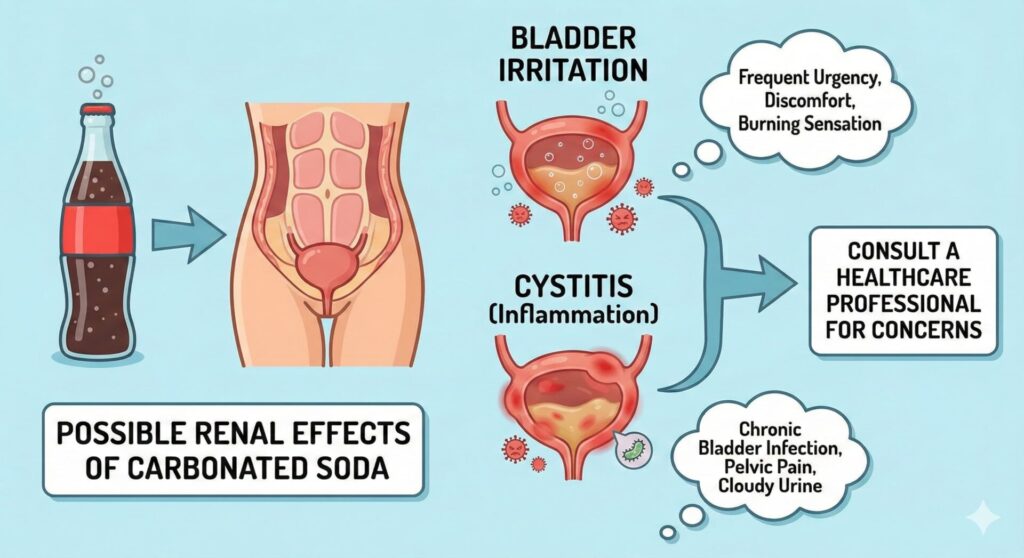
Carbonated beverages, diet or regular, can irritate the bladder lining in some people. Those with interstitial cystitis, frequent urinary urgency or overactive bladder often notice worse symptoms after fizzy drinks. This is due to acidity, CO₂ stimulation and sometimes sweeteners acting as irritants.
Carbonation itself has not been proven to cause urinary tract infections. But can it make you feel like you need to pee more urgently during an exam? That is a realistic yes.
Microbiome questions still unfolding
The gut microbiome is a hot scientific topic and a fertile ground for anxiety. Artificial sweeteners show measurable effects on bacterial populations in some studies. Carbonation itself is less studied. It changes local acidity and gas tension, and theoretically this could influence microbial balance. But strong human evidence is still evolving.
For now, the microbiome story should be told with curiosity, not panic.
Big disease headlines and the problem of confounding
You have probably seen headlines saying diet soda is linked with diabetes, stroke or heart disease. The key word is linked.
People who switch to diet soda often do so because they already have obesity, prediabetes or health concerns. That is reverse causation. The risk leads to diet soda, not always the other way round. Even when statistical adjustment is attempted, lifestyle patterns remain tangled.
So is carbonation causing chronic disease? At present, the evidence does not prove it. But carbonation can influence appetite, reflux, habits and sleep patterns indirectly, which over time may shape health behaviors.
Science is a map drawn in pencil, not permanent marker. Things strongly believed in today can be very well busted myths, in the late 1800, cigerettes were sold in pharmacies for their ‘health benefits’ and today we know what those benefits are!
Everyday life: how this actually feels
Picture three scenarios many young adults live daily.
Exam week. You replace water with cans of diet soda because it tastes more exciting than hydration. You feel bloated, strangely still hungry, and your sleep is shallow because reflux burns when you lie flat. The fizz is not the villain of your semester, but it is not innocent either.
Night out. You mix alcohol with diet soda to “save calories”. Carbonation increases gastric emptying sensation, you drink more quickly, you get intoxicated faster. The next morning your teeth hurt, your stomach hurts and you vow never again. Until next weekend.
Gym day. You drink sparkling energy drinks before a workout and then wonder why burping mid squats nearly kills you. Carbonation increases gastric pressure. Your body answers in one loud syllable.
In each situation, carbonation interacts with real life, not just theory.
What carbonation is reasonably doing
Putting all the evidence together, carbonation: It produces gastric distension, bloating and belching. It can transiently relax the lower esophageal sphincter and aggravate reflux symptoms. It may stimulate ghrelin and increase hunger. It contributes to dental erosion due to acidity can irritate the bladder in sensitive individuals
What it probably does not independently do:
- cause major bone loss
- directly cause diabetes
- create chronic GERD on its own
- inevitably lead to obesity
Sometimes, it can even help symptoms of dyspepsia and constipation.
So should you stop drinking diet soda? If you are drinking three sugary sodas a day, switching to diet soda may actually lower your health risk. If you already drink water and then add a liter of diet soda daily, you gain no benefit and some discomfort.
What matters is not moral judgment but honest self-reflection.
Do you drink diet soda out of habit, stress or taste?
Does it replace water or add to total intake?
Does it worsen your bloating, teeth sensitivity or reflux?
Would sparkling water feel different from colas for you?
Your body answers these questions more truthfully than advertisements.
Final thoughts
Diet soda lives in the cultural space between vice and virtue. It feels like cheating the system. Sweetness without sugar. Satisfaction without calories. A life hack in a can.
But carbonation is not neutral. The bubbles you love are tiny pockets of physiology that stretch your stomach, soften your enamel, nudge your hunger and sometimes whisper to your esophagus that it should open the wrong way for a while.
This does not make diet soda poison. It makes it a tool. For some people, a bridge away from sugar. For others, a subtle contributor to discomfort. Moderation is not a slogan here; it is the boring, practical truth.
Next time you hear the hiss of a freshly opened can, enjoy the sound. But also know that the fizz has a story inside you. And like most stories involving the human body, it is complicated, slightly messy and much more interesting than the label suggests.