


You’re sitting in the back of a car, staring out of the window. The road bends, the vehicle sways, and slowly an unpleasant feeling creeps in. A quiet unease in your stomach turns to a mild headache, which worsens as the journey continues. This may feel like a trap that you cannot escape, but under all this is a silent argument between your brain, your eyes, and your senses.
P. S you are not alone.

Understanding motion sickness
Let’s take a few scenarios where you would have experienced this: You are in the back seat of a car and you are scrolling on your phone, you are playing a VR game, or you are on a cruise gently rocking with the waves. Notice something: motion sickness only occurs when you are moving, or your brain believes you are. Motion sickness is common and easily preventable; understanding why it occurs will get you closer to achieving that.
The Sensory Mismatch: What’s Really Happening Inside
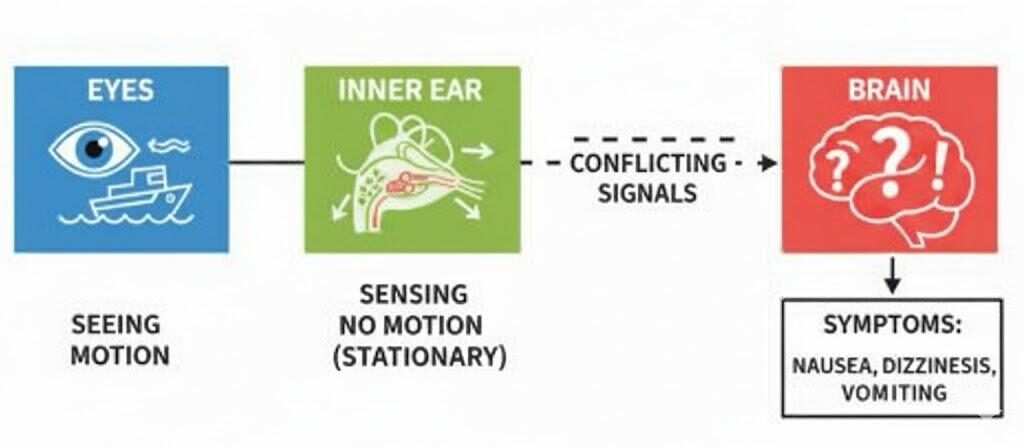
Your brain receives information from three main systems:
- Your eyes – what you see
- Your inner ear- your state of balance
- Your body/ joints – what your muscles and joints feel
Usually, during normal activities, these three systems agree with each other. But imagine you are sitting in a car and reading a book.
- Your eyes say – We’re not moving, the book is still
- Your inner ear says – We’re moving, the car is turning and speeding up
- Your body says – I feel some movement too
When these systems are in conflict, your brain gets confused which leads to nausea, dizziness, sweating, etc.
Common symptoms
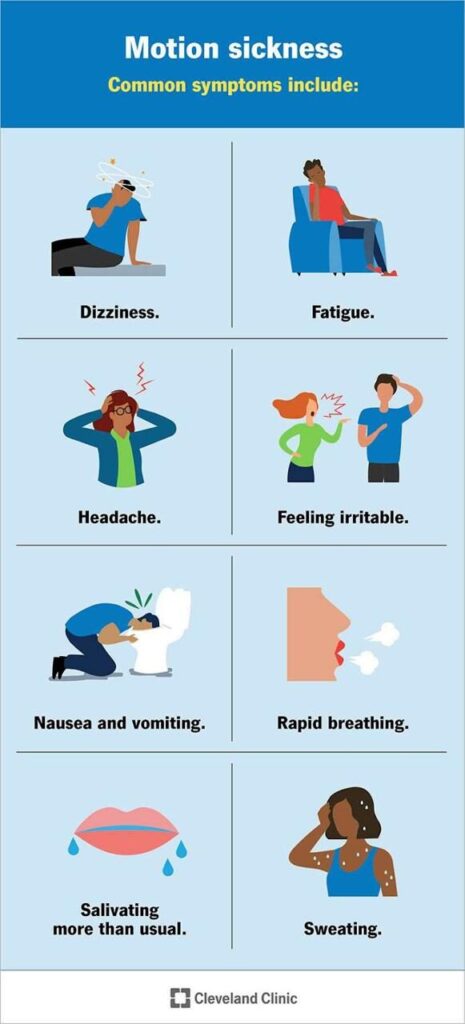
These are the symptoms of motion sickness that you might have experienced:
- Sweating
- Dizziness
- Fatigue
- Headache
- Nausea
- Vomiting
- Rapid breathing
Nausea might be aggravated by a full stomach, offensive odor, tobacco smoking, the sight of vomiting, fear, or excitement.
You may try to roll down your window for cool air. It provides temporary relief, but unless the trigger stops, the symptoms tend to worsen.
Who does it affect?
Motion sickness is a very common occurrence. Every person has experienced it at least once in their lifetime. About 46% of car passengers have reported experiencing it in the past 5 years. Having said that, few individuals are more susceptible to it than others.
- Women are more susceptible to motion sickness, pregnant women in particular.
- In children, 6 – 12 year olds are most susceptible with a peak between 9 and 10 years.
The incidence is reduced in adults through the process of habituation, where your body adapts. It is also seen in individuals who suffer from migraines, vertigo, and people who are exposed to low-wavelength light like the ones emitted from screens.
What triggers motion sickness?
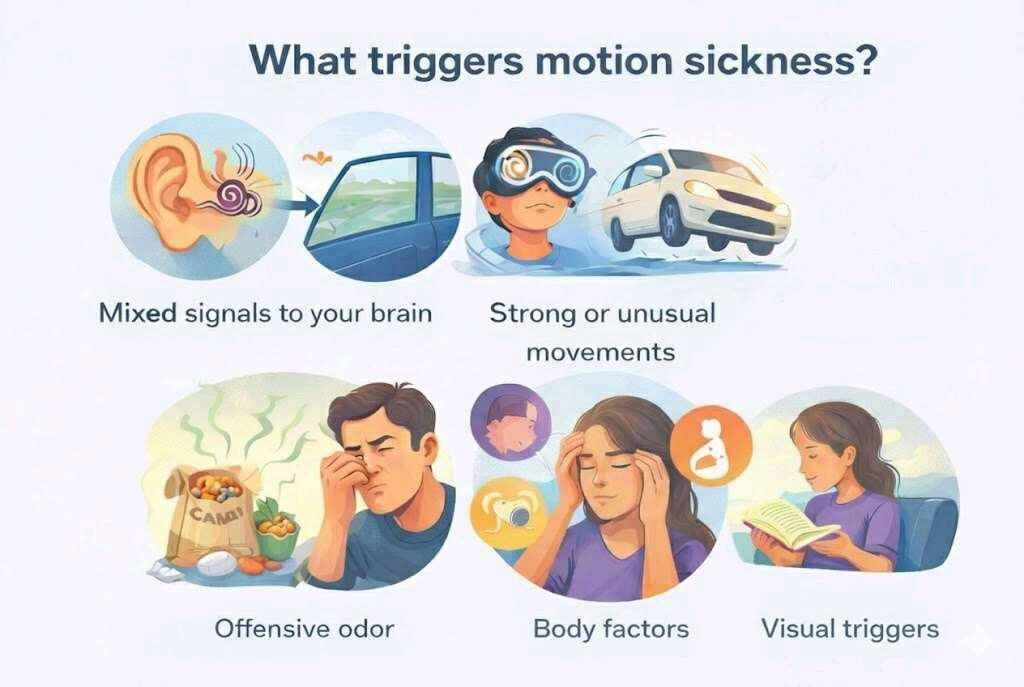
Every time you experienced this condition, these could have been the possible triggers for it:
- Mixed signals to your brain
- Reading in a moving car
- Looking down at your phone
- Sitting in the back seat with no view of the road
- Strong or unusual movements
- Bumpy roads, sharp turns
- Turbulence in a plane
- Big waves on a boat
- Visual triggers
- Playing video games or VR
- Seeing someone else throw up
- Offensive odor
- Cigarettes
- Fumes
- Strong perfumes
- Body factor
- Poor sleep
- Dehydration
- Drinking alcohol
- Anxiety
- Pregnancy
- If you are on certain medications.
How to reduce and prevent motion sickness?
Although medications are generally very effective for the treatment of this condition, more sustainable preventive measures should be tried as well. Recognizing situations that are likely to produce this sensation is the most important factor to allow for prevention of symptoms. Minimizing the amount of conflicting sensory stimuli should be our goal.
Habituation
If you slowly expose yourself to motion, your body can adapt, and the symptoms become milder.
For example: While playing games or VR, use it for a shorter duration of time till you adapt, or spend some time on a boat while in calm water before going on a trip.
How to position yourself in a vehicle?
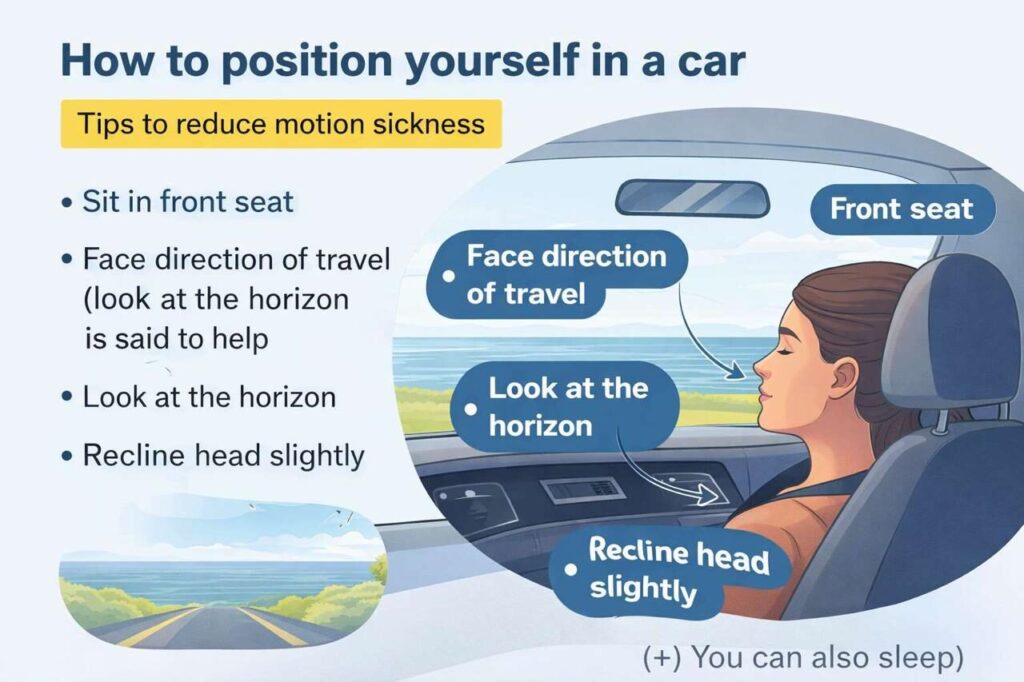
Try to stay in the most stable part of the vehicle and the place where you will receive the least conflicting stimulus.
In a car – Sit in the front seat, face in the direction of travel (looking at the horizon is said to help), recline your head slightly to limit vestibular stimulation (You can also sleep). In a boat – Near the middle, avoid the front and back of the deck and avoid head movements.
Behavioral Changes
Avoid reading, watching a video or a screen. Avoid having a heavy meal or drinking a lot before traveling. Avoid alcohol, nicotine, caffeine before travel. Controlled breathing has shown to suppress symptoms in mild cases.
Common remedies
- Ginger and peppermint
Has helped people with suppressing the effect of nausea.
- Acupressure bands
Wrist bands that press on a point inside the wrist. Can help some people and is worth trying.
- Fresh air
Opening your windows and getting fresh air goes a long way in reducing the effect.
Pharmacological Prevention (Medicines)

If the above remedies didn’t work, taking medications is also an option. Before taking any medication it is important to consult a doctor as these drugs might interact in an unexpected way with the medication you are already consuming.
- Antihistamines which are taken for allergies also help ease symptoms of motion sickness (Dramamine, Gravol – Dimenhydrate).
- Scopolamine patches or pills prevent nausea and vomiting but must be taken 4 hours before travelling.
When to seek professional help
These are red flag symptoms where you need to seek urgent care.
If dizziness/ nausea occurs with
- Sudden severe headache
- Weakness, facial drop, slurred speech
- Trouble walking, falling to one side
- Fever, severe ear pain
- After head injury, or after you surface from a deep dive
- Persistant vomiting
- If the symptoms last for >24 hours despite rest
When Fear of Travel Becomes the Real Barrier
When talking about motion sickness, we usually don’t realise the psychological effect it can have. After one or two unpleasant experiences, even the thought of traveling can fill someone with dread. There may be a constant worry that “because of me, the trip is ruined”. When you don’t know how to express these feelings, they can turn into frustration or anger. Even after reaching the destination, it can be hard to relax and enjoy while coping with the stress and discomfort associated with motion sickness.
It is important to know that this is not your fault. Motion sickness is a real and valid condition, not your personal shortcoming. With understanding and support, friends and family can plan ahead for a child or a friend who struggles with it and help manage both the physical symptoms and the emotional strain.
A little preparation and empathy can make travel more comfortable and enjoyable for everyone involved.
Conclusion
Motion sickness is a common and usually harmless, often causing discomfort and anxiety during travel. While the symptoms may feel overwhelming at the moment, they arise from a temporary sensory mismatch and are not a personal failing. With simple preventive measures, behavioral adjustments, and timely treatment, most individuals can significantly reduce symptoms and travel more comfortably.
For caregivers and parents, understanding triggers, planning ahead, and offering reassurance play a key role in easing both physical symptoms and emotional distress, especially in children, who often outgrow the condition with time. However, if symptoms are severe, persistent, or accompanied by unusual warning signs, seeking medical advice is important. With awareness, empathy, and the right support, motion sickness need not limit one’s ability to travel or enjoy the journey.
“A comfortable journey begins not with control over the road, but with understanding and care for the body that travels it.”
Sources