


Exhausted from those embarrassing flakes all over your scalp and shoulders? Don’t worry, you are not alone. Studies suggest that roughly 75% of the Indian population is suffering from this skin condition at some level of severity.
While it feels never-ending, dandruff doesn’t have to be your “new normal.” With the right guidance, you can silence the itch, clear the flakes, and get back to wearing black with total confidence.
This article will shed light on various aspects of dandruff, its closely related terminologies, causes, signs and symptoms, associations, misconceptions and treatment options, and ultimately understand how following a regular scalp and skin care routine can go a long way in banishing the flakes permanently.
Dandruff or something more?
Know your scalp better
Dandruff is the mild form of a fungal infection called Seborrheic dermatitis. It appears as loose, greasy white plaques with minimal or no redness. With a very few exceptions, the disease typically affects the scalp, and rarely ever forms well defined patches.
On the other hand, seborrheic dermatitis is associated with more redness, itching and heavy flaking. The most important differentiating feature is its distribution,i.e., it occurs over the eyebrows, sides of the nose or behind the ears and in fact in any damp and dark place, including the private parts.
What is normal?
Having a few flakes over your shoulders from time to time is completely normal. It may be as a result of stress, weather changes or even irregular hair washing. Note the difference; these flakes are white or off white in colour and not associated with itching or significant scalp changes.
However, when the flaking becomes heavy, persistent, or is associated with itching and redness; it is not normal and calls for immediate action. But one need not panic,as targeted and consistent medical approaches can help the skin underneath become healthy once again.
What causes dandruff?
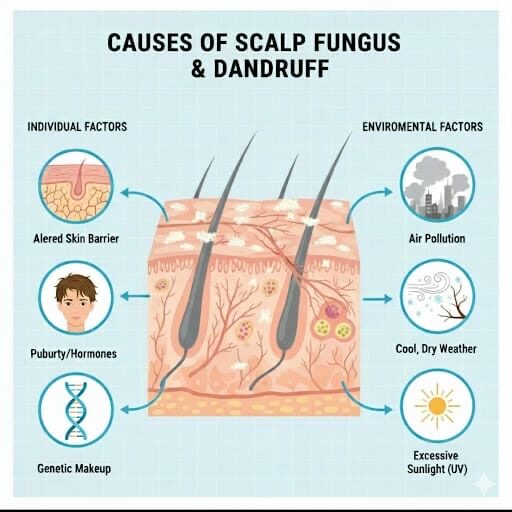
While the list of causes is unending, typically, occurrence of dandruff can be attributed to three primary factors, which are:
- Fungus in the scalp- Dandruff is most commonly caused by an overgrowth of Malassezia furfur, a yeast that thrives on natural scalp oils. While this microorganism is usually a harmless resident of the scalp, it can become problematic when it consumes excess sebum(oil). As it breaks down these oils, it releases irritating byproducts that trigger inflammation and result in flaking.
- Individual factors- These include altered skin barrier function, puberty (overactivity of oil glands is predominant in this phase of life.), genetic make up, etc.
- Environmental factors– Air pollution, cool and dry weather and excessive sunlight exposure are potential aggravating factors of dandruff.
All these conditions either provide a suitable environment for the yeast to further grow and multiply or hinder the maturation of the skin cells (called keratinocytes)
(Mayo clinic, NCBI, Bolognia Dermatology textbook)
Telltale Signs of dandruff
Dandruff can occur across all age groups, be it infants or the elderly. It may have a variety of presentation, but some of the cardinal signs include:
- Itchy scalp
- Thick white and dry flakes
- Scaly facial skin and presence of flakes over shoulders, which are easily visible while wearing dark clothings.
- Rashes over eyebrows, beard areas and center of the chest
- Rarely, rashes and flakes may be seen in the skin folds (armpit and private parts) and over the trunk.
Is it dandruff or something else?
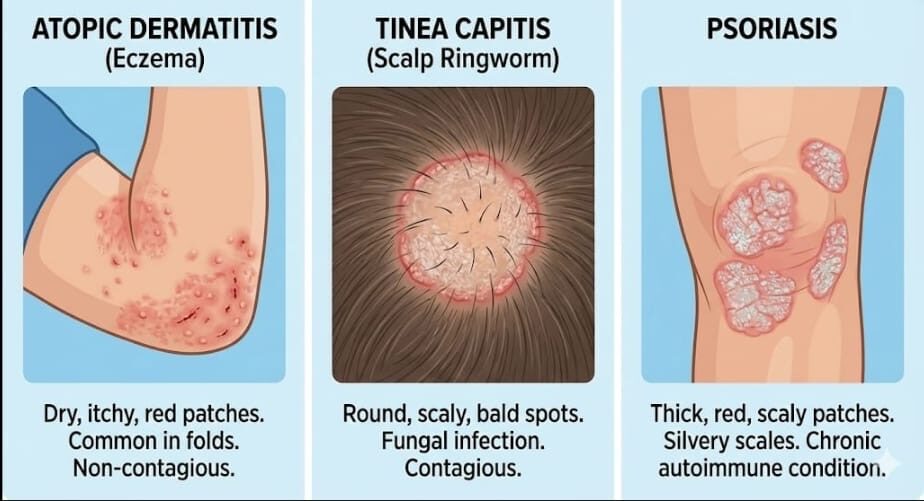
Many people assume all scalp flaking is dandruff, but conditions like eczema, psoriasis, and fungal infections can appear very similar—this comparison highlights the key differences.
| Feature | Tinea Capitis (Fungus) | Atopic Dermatitis (Eczema) | Psoriasis (Autoimmune) |
| Contagious? | Yes. Spreads through touch, hats, or pets. | No. It is a genetic/barrier issue. | No. It is an internal immune issue. |
| Primary Location | Mostly the scalp; can affect eyebrows/lashes. | Creases of elbows and knees, face, and neck. | Outer elbows and knees, scalp, and lower back. |
| Texture & Feel | Scaly, tender, or painful; hair feels brittle. | Very dry, “leathery,” and intensely itchy. | Thick, raised plaques; may sting or burn. |
| Diagnostic “Clue” | “Black dots” (broken hair stubs) or swollen lymph nodes. | The “Itch-Scratch Cycle” (itching starts before the rash). | Silvery-white scales and clearly defined “border” edges. |
| Common Trigger | Contact with an infected person, animal, or soil. | Irritants like wool, harsh soaps, or sweat. | Physical skin injury, stress, or infections (like strep). |
Common myths and misconceptions around dandruff
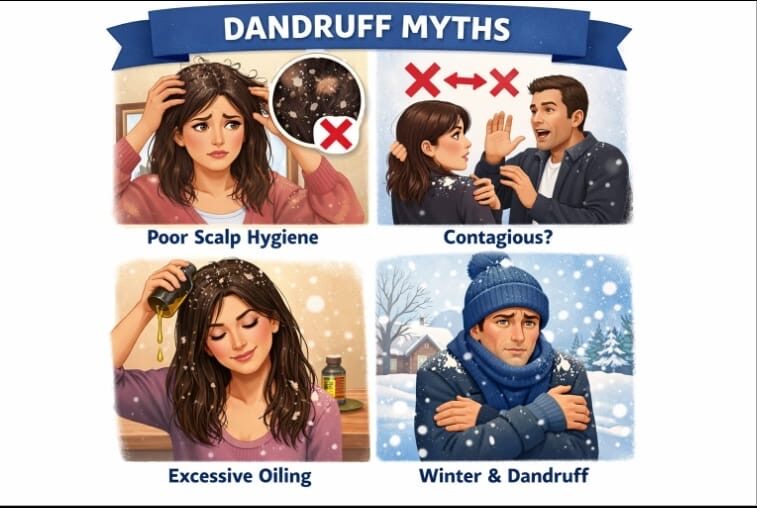
Despite being one of the most common scalp conditions, dandruff is also one among many diseases that is grossly misunderstood and is often surrounded by myths, unnecessary anxiety, stigma and ineffective self-care. Some of the key misconceptions include:
- Dandruff and poor hair hygiene, are the two related?
Not at all. Dirt and dust play no role in dandruff. Even a person who washes hair and scalp regularly develops dandruff. This is because the condition is more linked with scalp sensitivity, cold weather and fungus that colonize the scalp.
No case of person to person transmission has been noted.
Sharing towels, combs and pillows do not transmit the condition as dandruff is not an infection and rather an inflammatory condition.
- How does applying oil regularly affect the scalp?
In some, oiling the scalp has shown to increase moisture and prevent drying of the scalp, but in the vast majority, excessive oiling has only further worsened the condition by clogging the pores of the oil gland and further feeding the fungi, leading to itching, and increased flaking.
- Does dandruff occur only in the winter?
It is definitely true that dandruff worsens during winter, owing to the dry and cool climate. But it is not strictly a season specific condition, and can occur during any time of the year.
- Does dandruff cause permanent hair loss?
Dandruff itself does not cause baldness. However, severe itching and scratching can lead to temporary hair shedding, which usually improves once dandruff is controlled.
Treating dandruff: from household remedies to advanced treatment options
The unfortunate truth about dandruff is that it cannot be completely eliminated, however being consistent with medication and regular scalp hygiene is key to managing this condition. As per severity, the treatment options are as follows:
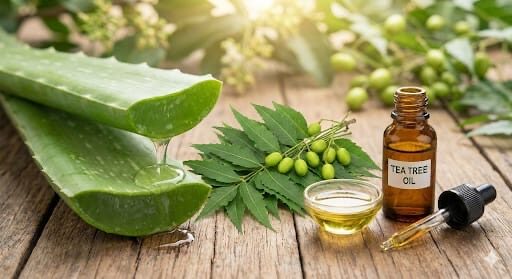
Natural ingredients such as aloe vera, neem, fenugreek, tea tree oil and lime juice can be effective for managing mild dandruff.
When flakes and itching become more consistent, the following types of therapeutic shampoos are advised-
- Anti-fungals like Ketoconazole, miconazole.
- Keratostatics and cytostatics (prevent excess skin cell formation) – Selenium sulfide, zinc pyrithione, salicylic acid, etc
Severe Dandruff-
While there are many treatment options available for stubborn cases, they are frequently expensive and unaffordable for some people.
- Topical(surface) corticosteroids – Hydrocortisone and Betamethasone dipropionate cream/lotion.
- Topical immunosuppressants – They work by reducing the body’s immune response, which in turn decreases the inflammation. Examples include Tacrolimus, Pimecrolimus, etc.
- Advanced treatment approaches include phototherapy (UV light), laser therapy and oxygen therapy.
DO’s and DON’Ts
Following these hacks can make a big difference in controlling dandruff on the long run:
- Use an anti dandruff shampoo that suits you according to a strict regimen as directed by your dermatologist or as indicated on the product label.
- Maintain a consistent washing schedule and focus on creating an even, moderate lather, while massaging the shampoo into your scalp.
- Managing stress is another key factor that can go a long way in controlling dandruff as it can prevent dandruff flare ups.
- Take the guesswork out of your hair care. When DIY solutions fall short, a dermatologist can offer the precise guidance needed to silence stubborn dandruff for good.
- Don’t soak your scalp in oil. As mentioned earlier, doing so can feed the dandruff causing fungi and can further worsen the condition
- Don’t stop once your scalp improves! Most cases of dandruff need non-stop care. Following the regimen is crucial to see better and long-lasting results.
- Your scalp is not a chemistry lab! Don’t experiment with new shampoos regularly. In most cases a single medicated shampoo can do the trick, patience and consistency is the key.
- Lastly, don’t ignore red flags! Persistent itching, redness, thick flakes which spread beyond the scalp need immediate medical attention.
CONCLUSION
Dandruff may be frustrating, but it does not have to undermine your confidence. Much of the anxiety surrounding this condition stems from widespread misconceptions that fuel social stigma and unnecessary fear. By understanding that dandruff is a common biological process—often driven by natural fungus, oil gland activity, and environmental triggers—you can strip away the shame and approach the issue with a clear, informed perspective.
Managing the condition effectively requires paying close attention to key symptoms such as flaking, itching, and localized redness. Recognizing these early signs allows for a proactive approach to care. When you move past the myths and focus on the “how” and “why” of your scalp’s health, the paranoia often associated with visible flakes begins to fade.
Ultimately, the timely pursuit of appropriate treatment, guided by a dermatologist, is the most reliable way to mitigate anxiety. Consistency in your hair care regimen not only clears your shoulders but significantly improves long-term scalp health. With the right knowledge and tools, you can silence the flakes and reclaim your confidence.